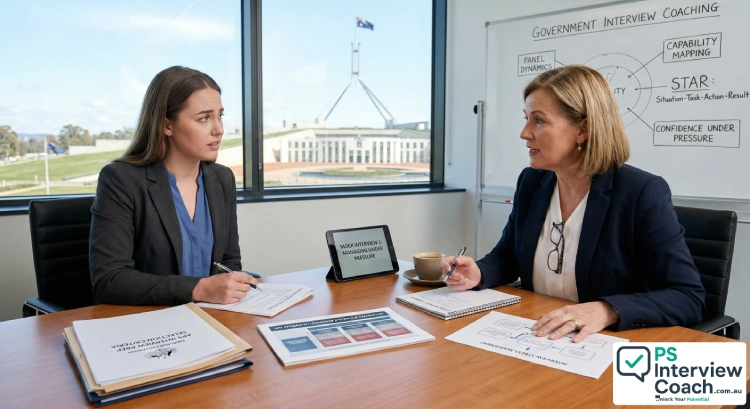
High Pressure Government Interview Coaching
The Direct Answer: To master high-pressure government interviews, seek coaching from former APS or State Government hiring managers who specialise in the Merit Principle and capability frameworks. Effective coaching must include mock interview simulations and training in the STAR method (Situation, Task, Action, Result) to provide the evidence-based responses panels require.
Securing a role in the public service is one of the most rewarding career moves you can make — but it is also one of the most competitive. Government interviews are not like anything you will encounter in the private sector. They are structured, scored, and conducted under strict merit-based principles that leave little room for vague or unprepared answers.
Whether you are applying for an APS3 entry-level position or an EL2 senior leadership role, the interview panel is evaluating you against a defined set of capabilities. Knowing what those are, how to address them, and how to perform under pressure is the difference between a conditional offer and a rejection letter. This guide covers everything you need to know.
Why Government Interviews Are Different
The single biggest mistake candidates make is treating a government interview like a private sector one. In the private sector, interviews often reward personality, cultural fit, and enthusiasm. In government, those qualities matter far less than your ability to demonstrate evidence of past behaviour mapped directly to the role’s capability requirements.
Government panels assess candidates based on the principle that past behaviour is the best predictor of future performance. Every question you are asked is deliberately designed to draw out a specific example from your experience. The panel is not looking for what you think you would do — they want to know what you have already done, how you did it, and what the outcome was.
Additionally, government interviews are conducted under the Australian Public Service Merit Principle, which means every candidate must be assessed consistently against the same criteria. Panels use scoring sheets, and every response you give is being evaluated in real time. There is no room for waffle, generalisation, or theoretical answers.
Understanding Capability Frameworks
Before you walk into any government interview, you need to understand the capability framework your target agency uses. These frameworks define the behaviours, skills, and attributes expected at each level of the public service.
At the Federal level, the Integrated Leadership System (ILS) outlines capabilities across five core clusters: Shapes Strategic Thinking, Achieves Results, Cultivates Productive Working Relationships, Exemplifies Personal Drive and Integrity, and Communicates with Influence. Each of these clusters has specific descriptors that shift in complexity depending on whether you are applying at the APS4, APS6, EL1, or EL2 level.
State governments use their own frameworks. For example, the NSW Public Sector uses the NSW Capability Framework, Victoria uses the Victorian Public Sector Capability Framework, and Queensland uses the Leadership Competencies for Queensland. Each has its own language, structure, and level descriptors. Applying for a state role without understanding the relevant framework puts you at an immediate disadvantage.
The practical implication of this is significant: you cannot rely on a one-size-fits-all set of interview answers. Your responses must be deliberately mapped to the specific capabilities being assessed for the specific role you are applying for.
Mastering the STAR Method
The STAR method — Situation, Task, Action, Result — is the foundation of all evidence-based government interview responses. Understanding it conceptually, however, is very different from being able to deliver it fluently under pressure in front of a three-person panel.
Situation sets the scene. You need to provide just enough context for the panel to understand the environment you were operating in — the organisation, the team size, the challenge or opportunity at hand. Keep this section brief. Many candidates spend too long here and run out of time before reaching the parts that matter most.
Task clarifies your specific role. This is where many candidates lose marks by being vague. The panel needs to understand exactly what you were personally responsible for, not what your team was doing. Government panels are specifically trained to probe for whether a response is genuinely individual or whether the candidate is borrowing credit from a group effort.
Action is the most critical section and should occupy the majority of your answer. This is where you describe what you specifically did, step by step, decision by decision. Use “I” statements consistently — “I identified,” “I escalated,” “I negotiated,” “I drafted.” Avoid “we” language unless you are explicitly describing a collaborative moment and immediately following it with your individual contribution to that collaboration.
Result closes the loop. Quantify the outcome wherever possible. Numbers, percentages, timeframes, and tangible deliverables all strengthen a result. If the outcome was qualitative — for example, an improvement in team morale or a strengthened stakeholder relationship — describe how you measured or observed that improvement.
Advanced STAR for Senior Roles
For APS6, EL1, and EL2 roles, basic STAR is not sufficient. At these levels, panels expect you to demonstrate strategic thinking, political acumen, and leadership under ambiguity. Your examples need to reflect complexity — situations with competing priorities, sensitive stakeholder dynamics, limited resources, or significant organisational risk.
Advanced STAR involves layering your answers to show not just what you did, but why you made the decisions you made, what alternatives you considered and rejected, and how you brought others along with you. It also means being prepared to handle follow-up probe questions such as “What would you have done differently?” or “How did you manage the stakeholder who disagreed with your approach?”
Senior candidates should also be prepared for hypothetical scenario questions, which are increasingly used alongside behavioural questions at EL level interviews. These questions test your reasoning and judgment in real time, not just your ability to recall past examples.
Preparing Your Example Bank
One of the most effective preparation strategies is to build a personal example bank before your interview. This is a curated set of six to ten strong work examples drawn from your career that can be adapted to answer a wide range of capability-based questions.
When building your example bank, aim for examples that demonstrate complexity and impact. Avoid examples where you were simply following instructions or completing routine tasks — these rarely score well against mid-to-senior level capability descriptors. Instead, prioritise examples where you exercised judgment, managed conflict, led change, influenced without authority, or delivered results in difficult circumstances.
Once you have your examples, map each one to the capabilities in the role’s position description. Identify which capabilities each example best demonstrates, and look for any capability gaps — areas where you do not yet have a strong example prepared. Then work to either develop a new example from your experience or strengthen an existing one to fill that gap.
Performing Under Pressure: What High-Pressure Panels Actually Look Like
Government interview panels are often described by candidates as intimidating — and there is good reason for that. A typical panel consists of two to four interviewers, one of whom acts as the chair. Questions are delivered formally, often read directly from a prepared question script. Panel members take notes throughout. Eye contact can feel clinical. The environment is deliberately structured to be fair, not comfortable.
For many candidates, the pressure comes not just from the panel itself but from the awareness that they are being scored in real time. Knowing that every pause, every tangent, and every vague response is potentially costing them points creates a level of anxiety that is hard to replicate in low-stakes preparation.
The best way to address this is through repeated mock interview practice under realistic conditions. This means sitting across from another person, answering questions out loud, being timed, and receiving structured feedback. Practising in your head or writing out answers is useful but insufficient on its own. The physical and psychological experience of being observed and questioned is something you need to rehearse, not just plan for.
Managing Nerves and Thinking Time
It is entirely acceptable — and often viewed positively — to take a brief moment to gather your thoughts before answering a question. A simple phrase such as “That is a great question, let me take a moment to give you the best example” signals composure and confidence, not hesitation. Panels are experienced interviewers; they know the difference between a candidate who is nervous and one who is thoughtful.
If you lose your train of thought mid-answer, do not panic. Pause, take a breath, and briefly re-anchor yourself: “To bring that back to the result…” or “The key outcome of that action was…” These bridging phrases help you recover your structure without derailing the entire response.
If you genuinely cannot think of a strong example for a particular question, it is better to briefly acknowledge the limitation and pivot to the closest relevant example than to fabricate or over-inflate a weak one. Panels are skilled at probing, and an inflated example will collapse quickly under follow-up questioning.
Common Mistakes That Cost Candidates the Role
Understanding what not to do is just as valuable as knowing what to do. These are the most frequent errors that hiring managers report seeing in government interviews:
- Using “we” instead of “I”: Group-based answers fail to demonstrate individual capability. The panel is assessing you, not your team.
- Describing processes instead of actions: Saying “our team would escalate issues to the manager” describes a process. Saying “I identified a risk, prepared a one-page brief, and escalated directly to the Deputy Secretary within 24 hours” describes an action. Panels want actions.
- Omitting the result: Many candidates give strong Situation, Task, and Action components but then trail off with a vague conclusion. Always close with a concrete outcome.
- Over-preparing generic examples: Memorised answers that have not been tailored to the specific capability descriptors of the role often feel rehearsed and hollow. Panels can tell when an answer has been copy-pasted from a script versus genuinely recalled from experience.
- Failing to demonstrate the right level: An APS6 candidate telling APS3-level stories, or an EL1 candidate who cannot describe strategic leadership, will not score well regardless of how well structured their answers are. Your examples must reflect the complexity expected at your target level.
- Neglecting to research the agency: Government panels often include questions about why you want to work for their specific agency. Vague answers about “wanting to serve the community” are unconvincing. Know the agency’s strategic plan, current priorities, and recent initiatives.
What to Look for in a Government Interview Coach
Not all interview coaching is equal, and for government roles specifically, the gap between a generalist career coach and a specialist public sector coach is significant. When evaluating coaching providers, look for the following:
1. Former Hiring Manager Experience
Coaches who have previously sat on government interview panels bring a fundamentally different perspective to preparation. They know exactly how scoring sheets work, what distinguishes a three out of five response from a five out of five response, and which “red flags” cause panels to immediately discount an otherwise strong candidate. This insider knowledge is not something that can be replicated from reading interview guides or studying capability frameworks from the outside.
2. Jurisdiction-Specific Knowledge
High-pressure coaching must be tailored to the level and jurisdiction you are targeting. Federal APS roles emphasise strategic policy, leadership of systems, and ministerial environment awareness. State government roles often have a stronger operational service delivery focus. Local government interviews have their own community-orientation expectations. A coach who does not understand these distinctions will give you advice that is generic at best and actively misleading at worst.
3. Structured Mock Interview Sessions
Reading about interview technique is useful. Being coached through it in a live mock interview environment is transformative. Look for providers who offer real-time mock interview simulations with immediate, specific feedback — not just a debrief at the end, but in-session guidance that helps you understand in the moment where your answer succeeded and where it fell short.
4. Tailored Example Development
The best coaches do not just tell you what to say — they help you excavate and articulate the genuine strengths already present in your experience. A strong coach will work through your career history with you, identify your highest-value examples, and help you structure and refine them to align precisely with the capability descriptors of your target role.
5. Ongoing Support Through the Process
Government recruitment processes can be lengthy and involve multiple stages — written applications, work sample exercises, psychometric testing, and interviews. Look for a coaching provider who can support you across the full process, not just in the 48 hours before your interview.
How Many Sessions Do You Need?
This depends heavily on your starting point and the seniority of the role. For candidates with some interview experience applying at APS3 to APS5 levels, two to three focused sessions is typically sufficient to sharpen technique and build confidence. For candidates applying at APS6 to EL1 level, or for those who have previously been unsuccessful in government interviews, three to five sessions allows enough time to thoroughly develop your example bank, practice across a range of question types, and address specific weaknesses. EL2 and SES candidates are navigating the most complex interview environments and often benefit from a more extended engagement that includes scenario-based preparation and leadership narrative development.
The most important thing is not the number of sessions but the quality of practice between them. Coaching works when candidates take the feedback seriously, rework their examples, and come back prepared to test the improvements.
Final Preparation: The Week Before Your Interview
In the final week before your interview, your focus should shift from developing new material to consolidating and rehearsing what you already have. Re-read the position description and identify the three to five capabilities most likely to be assessed. Review your example bank and confirm you have a strong, tailored story for each. Practice delivering your answers out loud — ideally with another person, but even solo practice in front of a mirror or recording yourself on your phone provides valuable feedback.
Research the agency’s current strategic priorities. Check their website, recent ministerial statements, and any publicly available annual reports. Being able to reference current agency priorities naturally in your answers signals genuine interest and organisational awareness.
On the day itself, arrive early, dress professionally, and remember that composure is itself a form of evidence. Government panels are assessing your ability to operate effectively under pressure — and how you carry yourself from the moment you enter the room is part of that assessment.
Ready to Excel in Your Government Interview?
Working with a coach who has sat on the other side of the interview table is the most direct path to understanding exactly what government panels are looking for — and how to give it to them. Our team of former APS and State Government hiring managers provides tailored, high-impact coaching for candidates at every level of the public sector.