
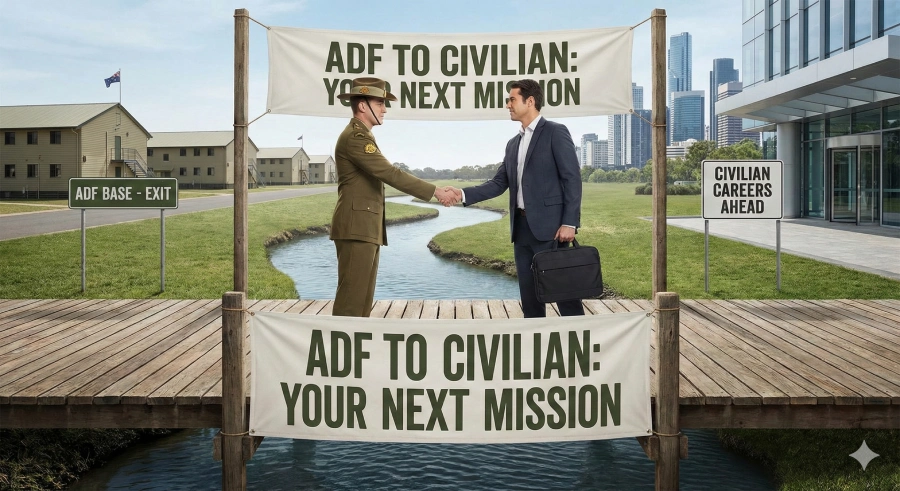
Your ADF to Civilian Career Transition: Why Experience Matters When Choosing Your Coach
Written by former Defence employees who’ve walked the path you’re about to take
After years of dedicated service in the Australian Defence Force, the transition to civilian life represents one of the most significant career changes you’ll ever make. It’s not just about finding a new job—it’s about translating your military experience into civilian language, understanding a completely different workplace culture, and navigating recruitment processes that bear little resemblance to ADF career progression.
Our Veteran Career Support Transition Program
At PS Interview Coach, we understand this transition intimately because we’ve lived it. With over 40 years of combined government and Defence experience, including roles across the Australian Public Service (APS), Department of Defence, DFAT, and other military-linked agencies, we’re uniquely positioned to guide your transition from uniform to civilian career success.
The Reality of ADF Career Transition: More Than Just a Job Search
If you’re currently serving or recently discharged from the ADF, you already know that military service develops exceptional skills: leadership under pressure, strategic thinking, adaptability, teamwork, and an uncompromising commitment to excellence. You’ve managed complex operations, led diverse teams, made critical decisions with incomplete information, and maintained composure in high-stress environments.
Yet despite these strengths, many ADF members struggle with career transition. Why?
The Hidden Challenges Veterans Face
1. The Translation Gap
Military achievements don’t always translate directly to civilian selection criteria. Your experience commanding a section of 10 personnel in challenging conditions is leadership gold—but how do you articulate it in a way that resonates with APS hiring panels who’ve never worn a uniform?
2. Different Selection Processes
ADF promotion boards assess potential differently than civilian interview panels. The APS uses structured behavioural interviews, written applications addressing specific selection criteria, and competency frameworks that may seem foreign after years in Defence.
3. Cultural Adjustment
The direct communication style valued in military settings can be misinterpreted in civilian workplaces. Understanding nuanced civilian workplace dynamics, stakeholder management, and the less hierarchical nature of many APS roles requires guidance.
4. Imposter Syndrome
Many veterans question whether their skills are “relevant” in civilian roles, despite having led in more demanding situations than most civilian managers will ever face. This self-doubt can undermine otherwise strong applications and interviews.
5. The Civilian Recruitment Process
From STAR method responses to addressing selection criteria, civilian recruitment has its own language and expectations. Without insider knowledge, even highly qualified veterans can be screened out before they reach the interview stage.
Why Your Transition Coach’s Background Matters
Career coaching isn’t one-size-fits-all, and this is especially true for ADF transition. The difference between a coach who understands military service and one who doesn’t is substantial.
What Generic Career Coaches Miss
Well-meaning career advisers without military or government backgrounds often:
- Undervalue military experience: They don’t recognise how your section commander role translates to high-level civilian leadership, or how your operational planning experience applies to strategic project management
- Misunderstand the APS: They give generic advice that doesn’t account for the unique culture, values, and recruitment practices of government departments
- Overlook veteran advantages: They fail to leverage the respect and value that Defence experience carries within government agencies
- Apply civilian frameworks incorrectly: They don’t know how to bridge military achievements with APS competency frameworks in authentic, compelling ways
- Miss insider opportunities: They’re unaware of veteran-specific pathways, Defence-linked roles, and government positions that actively value military backgrounds
The PS Interview Coach Difference: Lived Experience
At PS Interview Coach, our founders—Chris and the team—are former Defence employees ourselves. We’ve made the exact transition you’re contemplating. We’ve sat on both sides of the table: as transitioning veterans navigating civilian recruitment, and as government hiring managers assessing candidates.
This dual perspective is invaluable because we can:
- Speak your language: We understand military terminology, rank structures, and the context of your achievements
- Translate effectively: We know exactly how to reframe your military experience for civilian hiring panels
- Navigate APS culture: With 40+ years across government departments including Defence, DFAT, and ASD, we understand the unwritten rules, cultural expectations, and what different agencies value
- Leverage insider knowledge: We know which departments actively seek veterans, which roles suit military backgrounds, and how to position you competitively
- Provide realistic guidance: We offer honest assessments of role suitability, realistic timelines, and strategic career advice based on actual government experience
- Offer genuine empathy: We’ve felt the uncertainty, the cultural adjustment, and the challenge of proving yourself in a new environment
High-Value Civilian Career Paths for ADF Veterans
Your military background is particularly valuable in specific government sectors. Based on our experience, here are the most natural and rewarding transition paths:
1. Department of Defence (Civilian Roles)
Defence actively values military experience in civilian positions. Your understanding of military culture, operations, and organisational structure gives you a significant advantage.
Ideal Roles:
- Project managers for Defence capability programs
- Strategic policy advisers
- Operations and logistics coordinators
- Defence industry liaison roles
- Military capability analysts
- Training and doctrine development
Why You’re Suited: You already understand Defence priorities, culture, and stakeholders. You can work effectively with serving members and understand operational requirements in ways civilian-only employees cannot.
2. Australian Signals Directorate (ASD)
ASD and intelligence agencies highly value the security clearances, operational experience, and disciplined approach that ADF members bring.
Ideal Roles:
- Intelligence analysts
- Cyber security specialists
- Operational support roles
- Strategic planning and assessment
- Technical project management
Why You’re Suited: Your existing security clearance, understanding of operational security, and experience managing sensitive information are significant assets.
3. Department of Foreign Affairs and Trade (DFAT)
DFAT values the international experience, cultural awareness, and strategic thinking that ADF service develops, particularly for those with deployment experience.
Ideal Roles:
- Defence and strategic policy advisers
- International security specialists
- Consular operations
- Trade and investment roles (particularly in defence industry)
- Regional security analysis
Why You’re Suited: Deployment experience, cross-cultural competence, and strategic awareness make you valuable for international roles.
4. Australian Submarine Corporation & Defence Industry
The expanding defence industry, particularly around submarine capability, actively recruits veterans for technical and project management roles.
Ideal Roles:
- Program and project managers
- Technical specialists and engineers
- Supply chain and logistics managers
- Quality assurance and compliance
- Training and capability development
Why You’re Suited: Understanding of military requirements, technical knowledge, and project discipline are essential in defence industry.
5. Home Affairs & Border-Related Agencies
Australian Border Force, immigration, and security agencies value operational experience, decision-making under pressure, and security awareness.
Ideal Roles:
- Border operations and enforcement
- Intelligence and risk assessment
- Compliance and investigation roles
- Emergency management and response
- Strategic security planning
Why You’re Suited: Operational discipline, security clearance, and ability to make sound decisions under pressure are core requirements.
6. Emergency Management & Resilience Agencies
State and federal emergency management agencies recognise that military experience is excellent preparation for crisis coordination and disaster response.
Ideal Roles:
- Emergency operations coordinators
- Crisis management planners
- Logistics and resource management
- Training and exercise development
- Strategic resilience planning
Why You’re Suited: Experience coordinating complex operations, managing under pressure, and working with diverse stakeholders translates directly.
7. Broader APS Leadership & Management
Your leadership experience is valuable across the entire public service, from operational management to strategic policy development.
Ideal Roles:
- Program and project managers across any portfolio
- Team leaders and middle management
- Strategic planning and policy officers
- Organisational change and transformation specialists
- Governance and risk management
Why You’re Suited: Leadership, strategic thinking, and ability to deliver under constraints are universally valued APS competencies.
Translating Your ADF Experience: Real Examples
One of the most critical aspects of successful transition is learning to “translate” your military achievements. Here’s how we help veterans reframe their experience:
Example 1: Section Commander to APS Team Leader
Military Experience:
“Section Commander, 2nd Battalion. Commanded 10 personnel during Operation [X], maintaining operational readiness and achieving all mission objectives in a high-threat environment.”
Civilian Translation:
“Led a geographically dispersed team of 10 professionals in a high-pressure operational environment requiring 24/7 response capability. Developed team capabilities through structured training and mentoring, achieving 100% operational readiness targets while maintaining team wellbeing and morale. Managed complex stakeholder relationships and coordinated resources across multiple agencies to deliver critical outcomes under tight timeframes and resource constraints.”
Why It Works: Emphasises leadership, team development, stakeholder management, and delivery under pressure—all key APS competencies—while removing military-specific jargon.
Example 2: Operations Officer to Strategic Project Manager
Military Experience:
“Operations Officer, deployed to [location]. Planned and coordinated multi-unit operations, managed logistics, and maintained operational security.”
Civilian Translation:
“Managed complex, multi-stakeholder projects involving coordination across 5+ organisational units and external partners. Developed strategic plans, allocated resources efficiently, and maintained rigorous risk management and security protocols. Delivered critical outcomes within strict budget and timeline constraints while adapting to rapidly changing operational requirements. Managed sensitive information in accordance with strict governance frameworks.”
Why It Works: Highlights project management, strategic planning, risk management, and stakeholder coordination in civilian-friendly language.
Example 3: Training Instructor to Learning & Development Specialist
Military Experience:
“Qualified instructor at [School]. Delivered technical and leadership training to junior and senior personnel. Developed training materials and assessed competency.”
Civilian Translation:
“Designed and delivered comprehensive capability development programs for diverse audiences ranging from entry-level staff to senior leaders. Conducted needs analysis, developed evidence-based training frameworks, and assessed participant competency against defined standards. Continuously improved program effectiveness through feedback analysis and alignment with organisational objectives, achieving 95% participant satisfaction ratings.”
Why It Works: Reframes training expertise using learning and development terminology while emphasising assessment, continuous improvement, and stakeholder satisfaction.
The Critical Components of Successful ADF Transition
Based on our experience supporting dozens of veterans into civilian government roles, successful transition requires support in four key areas:
1. Strategic Career Planning
Not all government roles are created equal, and not all are ideal fits for your particular military background. We help you:
- Identify roles that genuinely align with your experience and career goals
- Understand which departments and agencies actively value military backgrounds
- Assess realistic salary expectations and classification levels
- Map short-term and long-term career pathways in the APS
- Leverage your existing security clearance and networks strategically
- Identify skills gaps and professional development opportunities
2. Application Writing & Selection Criteria
APS applications require addressing selection criteria—often 4-8 specific statements demonstrating your capability against role requirements. This is where many veterans stumble, either underselling their achievements or using language that doesn’t resonate with civilian panels.
We provide:
- Expert selection criteria writing services
- Translation of military experience to civilian competency frameworks
- Guidance on which experiences best demonstrate required capabilities
- Review and refinement to ensure applications are competitive
- Strategic advice on tailoring applications to specific agencies
3. Interview Preparation & Coaching
APS interviews follow structured behavioural formats, typically using the STAR method (Situation, Task, Action, Result). Panels assess against defined competencies, and responses must provide specific examples with measurable outcomes.
Our interview coaching includes:
- Training on the STAR framework and how to structure compelling responses
- Development of 8-12 strong examples from your military experience
- Translation of these examples into civilian-appropriate language
- Mock interviews with feedback from former APS hiring managers
- Guidance on presentation, communication style, and panel dynamics
- Preparation for common veteran-specific questions and concerns
- Strategies for addressing employment gaps or medical discharge sensitively
4. Cultural Integration & Workplace Adjustment
The transition isn’t over when you accept the job offer. Understanding and adapting to civilian workplace culture is essential for long-term success.
We provide guidance on:
- APS values, ethics, and code of conduct expectations
- Navigating less hierarchical workplace structures
- Adapting communication styles for civilian contexts
- Building relationships and networks in government
- Understanding APS performance management and promotion pathways
- Managing the emotional aspects of transition and identity shift
Common Mistakes Veterans Make (And How to Avoid Them)
Through our work with transitioning ADF members, we’ve identified recurring mistakes that cost veterans opportunities:
Mistake 1: Using Military Jargon and Acronyms
The Problem: Applications and interviews filled with military terminology that civilian panels don’t understand (or must constantly Google).
The Solution: Translate every military term into civilian language. Instead of “OC of Bravo Company,” say “senior manager responsible for 120 personnel.” Instead of “conducted BPT for Operation [X],” say “developed contingency plans for critical operations.”
Mistake 2: Underselling Achievements
The Problem: Military culture values humility and team success. Many veterans downplay their individual contributions or fail to quantify achievements.
The Solution: APS applications and interviews require clear articulation of YOUR specific actions and measurable outcomes. It’s not boasting—it’s evidence of capability. We help you strike the right balance.
Mistake 3: Focusing on Technical Skills Over Leadership
The Problem: Veterans often emphasise technical qualifications (trade certifications, operational skills) while undervaluing their leadership, strategic thinking, and people management experience.
The Solution: Most APS roles value leadership and strategic capabilities above technical skills. We help you reframe your experience to emphasise these higher-value competencies.
Mistake 4: Applying for Roles Too Junior for Their Experience
The Problem: Uncertainty about civilian classification levels leads many veterans to apply for roles well below their capability, effectively taking pay cuts and underselling themselves.
The Solution: Understanding APS classification levels and which align with your military rank and experience. A Warrant Officer or Senior NCO often maps to APS6 or EL1 roles, not APS3-4. We provide realistic assessments.
Mistake 5: Not Leveraging Existing Networks
The Problem: Veterans often don’t realise the value of their existing Defence and veteran networks in identifying opportunities and getting insider referrals.
The Solution: Strategic networking advice, including how to leverage LinkedIn, veteran employment programs, and Defence connections ethically and effectively.
Mistake 6: Inadequate Preparation for Civilian Interview Format
The Problem: Assuming military promotion board experience prepares you for APS behavioural interviews. It doesn’t—the format, expectations, and assessment criteria are fundamentally different.
The Solution: Comprehensive interview coaching specifically designed for veterans, addressing both the technical format and the cultural adjustment required.
Mistake 7: Ignoring Selection Criteria or Treating Them Casually
The Problem: Submitting a standard resume instead of addressing each selection criterion comprehensively, or providing generic responses that could apply to anyone.
The Solution: Treating each selection criterion as a mini-essay requiring specific examples, clear structure, and evidence of capability. Generic applications are eliminated before reaching interview stage.
Your Security Clearance: A Valuable Asset
If you hold an active security clearance (NV1, NV2, PV, TSPV), you possess a significant competitive advantage that many civilians don’t have. Security clearances can take 6-18 months to obtain and cost employers tens of thousands of dollars.
How to Leverage Your Clearance:
- Highlight it prominently in your resume and applications
- Understand expiry timelines and seek roles before clearance lapses
- Target positions requiring clearance where your advantage is maximised
- Maintain your clearance even if initially pursuing unclassified roles
- Emphasise your understanding of security protocols and information management
Many veterans don’t realise that clearance alone can move them to the top of the shortlist for security-focused roles in Defence, ASD, intelligence agencies, and other classified environments.
Special Considerations for Medical Discharge & DVA Support
If you’re transitioning due to medical discharge or managing service-related injuries, additional considerations apply:
Managing Disclosure Appropriately
You’re not required to disclose medical conditions unless they affect your ability to perform essential role functions. We help you:
- Understand what must be disclosed and what’s private
- Frame service-related challenges positively where relevant
- Request reasonable workplace adjustments without undermining your application
- Navigate questions about employment gaps or early discharge sensitively
DVA Support Programs
Veterans may be eligible for:
- Career transition assistance and training funding through DVA
- Priority consideration in APS recruitment (for eligible veterans)
- Mentoring and support programs
- Workplace adjustment funding for adaptive equipment or support
We help you navigate these programs and incorporate available support into your transition strategy.
The Emotional Reality of Career Transition
Let’s be honest: leaving the ADF is emotionally challenging, even when it’s the right decision. Military service shapes identity, provides clear purpose, and creates bonds that civilian workplaces rarely replicate.
It’s normal to experience:
- Loss of identity: “Soldier” or “sailor” has been central to who you are for years
- Grief for camaraderie: The bonds formed in service are difficult to find elsewhere
- Uncertainty about purpose: Civilian work can feel less meaningful initially
- Frustration with civilian pace: Things often move more slowly and bureaucratically
- Anxiety about fitting in: Worrying that you won’t adapt or be accepted
- Financial stress: Particularly if transitioning takes longer than expected
Working with coaches who’ve experienced this transition means you’re not just getting technical support—you’re getting empathy, realistic expectations, and reassurance from people who’ve been exactly where you are.
Success Stories: Veterans We’ve Helped Transition
Note: Details modified to protect client confidentiality
Case Study 1: From Infantry Officer to Defence Strategic Policy
Background: Former Army Captain with 12 years’ service, multiple deployments, and command experience. Initially applied for APS4-5 operational roles, unsure of his civilian value.
Our Support: Identified his strategic planning and international experience as ideal for policy roles. Helped develop applications for EL1 positions in Defence strategic policy branch.
Outcome: Secured EL1 role in Defence strategic policy at $40K+ higher than his initial target roles. Now advises on military capability and international engagement—directly leveraging his service experience.
Case Study 2: From Aviation Technician to ASD Technical Specialist
Background: RAAF technical specialist with NV2 clearance, medically discharged after 8 years. Concerned injury would limit opportunities.
Our Support: Emphasised technical expertise, security clearance, and problem-solving abilities. Prepared for behavioural interviews focusing on technical challenges overcome. Addressed medical discharge sensitively without undermining capability.
Outcome: Secured APS6 technical specialist role at ASD within 6 weeks of discharge. Clearance and technical background made him immediately competitive. Workplace adjustments accommodated without issue.
Case Study 3: From Navy Logistics Officer to DFAT Operations
Background: Navy Lieutenant with supply chain and logistics experience, deployment to SE Asia. Wanted international-facing role but unsure how to position military logistics for DFAT.
Our Support: Reframed logistics experience as program management, emphasised cross-cultural competence from deployment, and prepared for DFAT’s competency-based interview process.
Outcome: Secured EL1 position in DFAT operations, managing international programs. Deployment experience and cultural awareness proved decisive factors.
Why Choose PS Interview Coach for Your ADF Transition
The veteran employment support market includes many options: DVA programs, veteran employment agencies, general career coaches, and resume writers. So why choose PS Interview Coach?
1. Genuine Defence & APS Experience
We’re not just coaches who’ve read about Defence—we’re former Defence employees who’ve lived the transition ourselves. Our 40+ years of combined government experience, including time in Defence, DFAT, and other agencies, means we understand both sides of your journey.
2. Insider Knowledge of Government Recruitment
We’ve served on APS hiring panels. We know what they’re looking for, how applications are assessed, what makes a candidate stand out, and what causes immediate elimination. This insider perspective is invaluable.
3. Specialist Focus on Government & Defence-Linked Roles
We don’t try to be everything to everyone. Our specialist focus is government and defence-adjacent roles because that’s where veteran skills are most valued and where we can provide the greatest value.
4. Proven Track Record
We’ve successfully supported dozens of veterans into APS roles across Defence, ASD, DFAT, Home Affairs, and other agencies. Our clients consistently report that our coaching was the difference between rejection and success.
5. Comprehensive Support Beyond Just Interviews
While many services focus only on resume writing or only on interview prep, we provide end-to-end support: career strategy, application writing, interview coaching, and post-placement advice. Your transition is a journey, not a single event.
6. Understanding of Military Culture & Values
We speak your language. We understand the pride of service, the challenge of leaving, and the importance of finding meaningful work that honours your contribution. We also understand the frustrations of dealing with civilian processes that seem inefficient compared to military clarity.
7. Personalised, Not Generic
Every veteran’s experience is unique. We provide personalised coaching based on YOUR specific background, goals, and circumstances—not templated approaches that treat all transitioning members the same.
What to Expect When Working With Us
Our veteran transition support is collaborative and comprehensive:
Initial Consultation (Free)
We start with a free consultation to understand:
- Your military background and service experience
- Your career goals and interests
- Your timeline and constraints
- Your concerns and questions about transition
- How we can best support your specific needs
This consultation is genuinely free with no obligation—we want to ensure we’re the right fit for you as much as you want to assess whether we can help.
Strategic Career Planning Session
Before diving into applications, we develop a clear strategy:
- Identify target roles and departments that align with your background
- Assess realistic classification levels and salary expectations
- Map short and long-term career pathways
- Identify any skills gaps or professional development needs
- Create a structured job search and application timeline
Application Development
For each role you target, we provide:
- Review of position requirements and selection criteria
- Identification of relevant military experiences
- Translation of these experiences into civilian language
- Drafting and refinement of selection criteria responses
- Resume tailoring for government applications
- Cover letter development where required
Interview Preparation
Once you’re shortlisted, we provide comprehensive interview coaching:
- Training on STAR method and behavioural interview frameworks
- Development of 8-12 strong examples from your military experience
- Practice sessions with real-time feedback
- Mock interviews simulating panel format and questioning
- Refinement of communication style and presentation
- Preparation for common veteran-specific questions
- Final preparation session before your interview
Ongoing Support
Even after you’ve accepted a position, we’re available for:
- Onboarding advice and cultural adjustment tips
- Feedback on probation performance and expectations
- Guidance on professional development and APS career progression
- Support for subsequent applications as you advance your career
Investment in Your Future
We understand that transition can be financially stressful, particularly if you’re managing medical discharge or family considerations. However, investing in professional support typically pays for itself many times over through:
- Faster placement: Securing a role in 2-3 months instead of 12+ months
- Higher classification: Starting at EL1 instead of APS6 means $20-30K+ in additional annual salary
- Better role fit: Targeting strategic roles aligned with your experience rather than settling for operational positions
- Reduced stress: Confidence in your applications and interviews eliminates anxiety and false starts
- Career trajectory: Starting at the right level and in the right role sets the foundation for long-term career success
Many of our veteran clients tell us that our coaching was worth 10-20 times the investment when they consider the improved salary outcomes and faster placement.
We offer flexible payment options and can work with DVA funding where applicable. Your dedicated coaching package and pricing will be outlined on our upcoming ADF Transition Coaching page (link to be added).
Frequently Asked Questions from Transitioning Veterans
When should I start my transition preparation?
Ideally, 6-12 months before your intended discharge date. This allows time for strategic career planning, professional development if needed, and a methodical job search. However, we regularly support members who are transitioning immediately—it’s never too late to get expert help.
Will my military rank directly translate to an APS classification?
There’s no exact formula, but general guidelines exist:
- Junior enlisted (PTE-CPL): APS1-3
- Senior NCOs (SGT-WO): APS4-6 or EL1
- Junior Officers (2LT-CAPT): APS6-EL1
- Senior Officers (MAJ-LTCOL): EL1-EL2
- Senior Leadership (COL+): EL2-SES
However, your specific role, responsibilities, and achievements matter more than rank alone. We help you identify the right classification level for your unique experience.
Do I need a degree to work in the APS?
Not always. Many APS roles, particularly operational and technical positions, don’t require tertiary qualifications if you have relevant experience. However, qualifications can help with:
- Meeting essential criteria for some roles
- Competing for higher classification levels
- Long-term career progression to senior leadership
We provide honest assessments of whether additional qualifications would benefit your specific goals and can advise on recognition of prior learning (RPL) programs for veterans.
How long does APS recruitment typically take?
Unfortunately, often 3-6 months from application to job offer. Some agencies are faster, some slower. The process typically includes:
- Application closing and shortlisting: 2-4 weeks
- Interview scheduling: 2-6 weeks
- Interview panel deliberation: 1-2 weeks
- Reference checks: 1-2 weeks
- Security clearance (if required): 0-6 months depending on level
- Final approval and offer: 1-2 weeks
This is why starting early and applying for multiple roles concurrently is advisable.
Will my security clearance transfer?
Yes, security clearances transfer between government agencies and some cleared defence industry roles. However:
- You must maintain your clearance current (some agencies require re-vetting)
- Clearance level must match role requirements (NV1 won’t satisfy a PV requirement)
- Some agencies conduct additional vetting even with existing clearance
What if I was medically discharged?
Medical discharge doesn’t prevent APS employment. Key considerations:
- You must be able to perform essential role functions (with reasonable adjustment if needed)
- Disclosure is only required for conditions affecting role performance
- Many agencies have active diversity and inclusion programs supporting veterans with service-related injuries
- DVA can provide workplace adjustment funding in some cases
We help you navigate this sensitively and strategically.
Can I apply for APS roles while still serving?
Yes, and it’s advisable if you have a known discharge date. This allows you to:
- Secure a role before separation, reducing financial stress
- Time your discharge with your start date
- Maintain career momentum without gaps
Just ensure you can meet the proposed start date and that you’re not using Defence resources (time, equipment) for job searching.
What if I don’t have civilian work experience?
Your military experience IS work experience—it’s just differently structured. Many successful APS employees came straight from Defence with no civilian background. The key is translation, which is exactly what we specialise in.
Take the First Step Toward Your Civilian Career
Transitioning from the ADF to civilian life is challenging, but you don’t have to navigate it alone. With the right support, your military experience becomes a powerful competitive advantage in the government job market.
At PS Interview Coach, we’ve walked the path you’re on. We understand the uncertainty, the cultural adjustment, and the challenge of translating your service into civilian success. More importantly, we know how to help you do it effectively.
Your service has given you skills that civilian employers desperately need: leadership, resilience, strategic thinking, adaptability, and the ability to deliver under pressure. Let us help you communicate that value and secure the civilian career you deserve.
Ready to Start Your Transition?
In this no-obligation session, we’ll:
- Discuss your military background and career goals
- Identify target roles and realistic pathways
- Assess your current application and interview readiness
- Outline how we can support your specific transition needs
- Answer all your questions about APS recruitment and culture
Or explore our services:
- Interview Coaching Services →
- Selection Criteria Writing →
- Understanding the STAR Method →
- ADF Transition Coaching Packages → (dedicated page coming soon)
About Your Coaches
PS Interview Coach was founded by Chris and team members who are all former Defence and government employees with over 40 years of combined public sector experience. We’ve served in the Australian Defence Force, worked across Defence, DFAT, and other Commonwealth agencies, and successfully transitioned from military to civilian careers ourselves.
We created PS Interview Coach because we saw too many capable, dedicated veterans struggle with transition—not because they lacked skills, but because they lacked the insider knowledge and support to navigate civilian recruitment effectively. We’re committed to changing that, one successful transition at a time.
Our experience includes:
- Active ADF service across Army, Navy, and Air Force
- Civilian roles in Defence, DFAT, ASD, and broader APS
- Serving on government hiring panels and selection committees
- Managing teams of transitioning veterans in government roles
- Supporting dozens of veterans through successful APS transitions
When you work with us, you’re not just getting coaches—you’re getting mentors who genuinely understand your journey because we’ve lived it ourselves.
Our Veteran Career Support Transition Program
PS Interview Coach is Australia’s specialist in public sector recruitment preparation, with particular expertise in supporting ADF veterans transitioning to civilian government careers. We’ve helped hundreds of candidates secure roles with Defence, DFAT, ASD, Home Affairs, and other Commonwealth agencies.
Questions about ADF transition or our coaching services? Email us at info@psinterviewcoach.com.au or call (02) 6106 9669.
Disclaimer: PS Interview Coach is an independent coaching service and is not affiliated with or endorsed by the Australian Defence Force, Department of Defence, or any Commonwealth agency. All information is based on publicly available resources and our professional experience supporting veteran transitions.