
by APS Interview Coach | Jan 27, 2026 | Graduate Program Dates
Australian Government graduate programs are among the most competitive entry-level pathways
for graduates seeking long-term, stable and meaningful careers in the public sector.
Each year, thousands of applicants compete for a limited number of roles across
Federal, State and Territory Government agencies.
At PS Interview Coach, we specialise in helping graduates successfully navigate
APS and State Government recruitment processes — from written applications
through to interviews and merit pool placement.
Free Download Important Graduate Program Dates – PDF
APS-Graduate-Programs-Key-Dates-2026-2027
This guide provides:
- Key graduate program open and close dates
- Direct links to official government graduate programs
- Expert insights on how to stand out during assessments
- Preparation tips for the 2026 / 2027 intake cycle
Federal Government Graduate Programs (APS)
The Australian Public Service (APS) offers a centralised graduate intake covering
multiple agencies and specialist streams including policy, digital, data, finance,
economics and corporate roles.
APS Graduate Program (All Streams)
The APS Graduate Program is coordinated through the APS Jobs Career Pathways portal.
Applications typically open in early March each year for a commencement
the following February.
Key dates:
- Applications open: Early March (annually)
- Applications close: Varies by agency
- Program start: February the following year
👉 Official portal:
APS Graduate Programs
PS Interview Coach insight: Most applicants are screened out during the
written application and behavioural interview stage. Strong STAR responses
and alignment to APS values are essential.
Other Major Federal Graduate Programs
Most Federal graduate programs for the 2027 intake are expected to open
between February and April 2026.
State and Territory Government Graduate Programs
State and Territory Governments run their own graduate intakes, often mirroring
APS recruitment practices, including behavioural interviews and assessment centres.
Key State Graduate Programs
Most State graduate programs open between March and July
for a February start the following year.
Why the STAR Method Is Critical for Government Graduate Applications
One of the most common reasons graduates fail government interviews is not
lack of ability, but lack of structure in their answers.
Government interview panels expect candidates to use the
STAR method (Situation, Task, Action, Result)
to demonstrate capability, judgement and impact.
👉 Learn exactly how to structure winning responses here:
APS Interview STAR Method Explained
PS Interview Coach insight: Even strong graduates often undersell their experience.
Proper STAR framing can turn university, casual work and placements into
panel-ready examples.
Understanding Merit Pools: A Hidden Advantage for Graduates
Many graduate applicants mistakenly believe that missing out on an immediate offer
means failure. In reality, being placed in a merit pool is often a major win.
Merit pools allow agencies to offer roles for up to 12–18 months after the
initial recruitment process, sometimes across multiple departments.
👉 Read our full breakdown here:
Understanding the Competitive Advantage of APS Merit Pools
PS Interview Coach insight: Graduates who interview well but narrowly miss out
are often picked up later via merit pools — sometimes faster than reapplying.
How to Prepare Now for the 2026 / 2027 Graduate Intake
The biggest mistake graduates make is starting preparation after applications open.
By then, many top candidates are already interview-ready.
Our recommended preparation timeline:
- Now – December 2025: Understand APS capability frameworks and STAR responses
- January – February 2026: Prepare written applications and example bank
- March – July 2026: Interview coaching and assessment centre preparation
At PS Interview Coach, we help graduates:
- Structure strong STAR responses
- Translate study and casual work into APS-relevant examples
- Perform confidently in panel interviews
- Maximise chances of merit pool placement
Next step: If you’re serious about securing a government graduate role,
professional interview coaching can be the difference between
“almost” and “offer”.
by APS Interview Coach | Jan 27, 2026 | State Government Interview Coaching
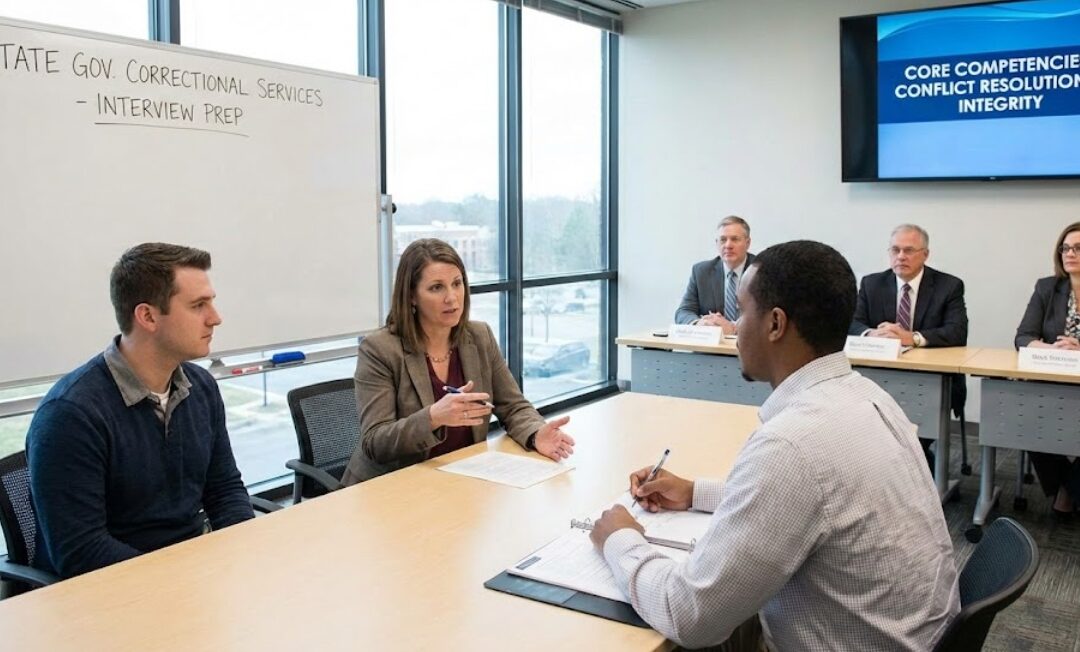
Correctional Officer Services Summary
Professional correctional officer interview coaching services across all Australian states by former senior public service executives with 40+ years combined experience. Specialised training in state government selection processes, behavioural interview techniques, and confidence-building strategies for correctional services roles including Custodial Officer, Youth Justice Officer, and Community Corrections positions.
Specialised State Government Correctional Officer Interview Coaching
Landing a correctional officer position in Australia’s state government sector requires more than just meeting the basic requirements—it demands expert interview preparation tailored to the unique challenges of correctional services recruitment.
Our former APS executives and state government hiring managers bring 40+ years combined experience conducting panels across NSW, Victoria, Queensland, South Australia, Western Australia, Tasmania, Northern Territory, and ACT correctional services departments.
Understanding State Correctional Services Interviews
State government correctional services interviews differ significantly from federal APS processes. Each jurisdiction—whether Corrective Services NSW, Corrections Victoria, Queensland Corrective Services, or other state departments—has specific behavioural competencies, scenario-based questions, and assessment criteria that candidates must master.
Private sector candidates often struggle with the structured format of government interviews, while those experiencing interview nerves, freezing under pressure, or speaking too fast find themselves unable to demonstrate their true capabilities despite having the right skills and experience.
Our Proven Correctional Officer Coaching Approach
We solve both challenges through our comprehensive coaching that combines:
Strategic Interview Preparation
- Master the STAR method specifically for correctional services competencies
- Learn high-scoring behavioural examples that panels actually want to hear
- Understand state government selection criteria and scoring frameworks
- Develop responses for common correctional officer scenarios including conflict resolution, teamwork under pressure, and ethical decision-making
Performance Psychology & Confidence Building
- Proven calm and grounding techniques that eliminate interview anxiety
- Strategies to stop freezing, control pace, and maintain composure
- Specialised training for candidates transitioning from private sector to state government roles
- Clear guidance that eliminates confusion from conflicting online advice
Why Choose Our Correctional Services Interview Coaching?
Unlike generic interview coaches, our team has sat on both sides of the table as senior decision-makers in government recruitment. We’ve conducted over 1,000 selection panels across federal, state, and local government—including specialist correctional services positions.
Our former senior executives don’t just teach interview theory—we reveal the insider knowledge of what panels are actually scoring, the subtle differences between answers that rank 3 versus 5, and the unwritten rules that consistently secure offers.
Comprehensive Support for All States & Correctional Roles
Whether you’re applying for:
- Custodial Officer positions in maximum or minimum security facilities
- Youth Justice Officer roles working with young offenders
- Community Corrections Officer positions managing offenders in the community
- Aboriginal Liaison Officer or specialised correctional services roles
We provide tailored coaching packages designed for your specific timeline, experience level, and target position across any Australian state jurisdiction.
Fast-Track Your Correctional Services Career
This investment doesn’t just prepare you for one interview—it’s lasting coaching that serves your entire public service career. The strategies, frameworks, and confidence techniques you master will elevate every promotion, every role change, and every high-stakes panel throughout your correctional services journey.
Have an urgent interview in 1-3 days? Our priority coaching services provide intensive preparation when you need it most, with former executives who understand the time-sensitive nature of government recruitment.
Get Started With Expert Correctional Officer Coaching
Stop navigating complex state government interviews alone. Book your free consultation today and discover how our proven insider strategies transform nervous, confused candidates into composed professionals who consistently win correctional officer positions across Australia.
Trusted by 370+ public servants Australia-wide | Former senior executives | 40+ years’ combined hiring experience | Proven track record across all states
Ready to secure your correctional services role? Contact our team of former government executives who’ve dedicated their careers to helping candidates like you succeed in state government recruitment.
by APS Interview Coach | Jan 23, 2026 | APS Level Pros and Cons, Public Service News
A question quietly doing the rounds in APS circles: if you had the chance to go permanent EL1, would you take it? Increasingly, the answer isn’t always yes.
There’s an assumption baked into most career conversations — that progression is always the goal, that the next rung on the ladder is always worth grabbing, and that saying no to a promotion is somehow a failure of ambition or confidence. In the Australian Public Service, where EL1 is often seen as a significant threshold — a move from “doing” to “leading” — that assumption runs particularly deep.
But a growing number of APS employees are quietly pushing back on that narrative. People who’ve acted at EL1, performed well, received positive feedback, and still chosen not to pursue the permanent role. Not because they couldn’t do it. But because, on reflection, they decided they didn’t want to — at least not right now, and not in this role.
If you’re sitting in that position, you’re not alone. And your decision is more valid than you might think.
Why People Walk Away from Permanent EL1
The reasons are as varied as the people making the decision, but a few themes come up again and again.
The role or the area isn’t the right fit. Acting opportunities don’t always land in places that align with your long-term interests. You can perform well in a role — meet the standards, earn the feedback — while simultaneously knowing that the work, the team, or the business area isn’t where you want to build a career. Accepting a permanent role in the wrong place just to hold the classification is a trade-off that many people, on reflection, aren’t willing to make.
Personal life is a legitimate priority. EL1 brings with it a meaningful step up in responsibility — more complex work, people management expectations, greater accountability, and often longer hours. For someone going through a significant life phase — young children, caring responsibilities, health, study, or simply a season where they want more space — that trade-off doesn’t always make sense. Protecting your personal life isn’t a retreat. It’s a considered choice about what matters right now.
The timing isn’t right. A permanent EL1 in the wrong agency, the wrong branch, or the wrong moment in your career can close doors as easily as it opens them. Mobility — the ability to move laterally, explore different policy areas, or apply for roles across the APS — can be more valuable at certain career stages than locking in at the next level.
They’d rather find the right EL1 than take the available one. There’s a real difference between going permanent EL1 in a role you’re lukewarm about and going permanent EL1 in a role you’re genuinely excited by. Holding out for the latter isn’t timidity. It’s strategy.
What You’re Not Losing
Here’s something worth sitting with: the experience doesn’t disappear just because you don’t take the permanent role.
The months you’ve spent acting at EL1 — the complexity you’ve navigated, the leadership you’ve demonstrated, the outcomes you’ve delivered — that’s all real, and it all goes on your record. When you do pursue an EL1 role that genuinely fits, you won’t be starting from scratch. You’ll be applying with evidence. That matters enormously in APS recruitment, where demonstrated ability at level is one of the strongest things you can bring to a selection process.
Choosing not to go permanent now is not the same as choosing never to go EL1. It’s choosing to be intentional about where and when you make that move.
The Question Worth Asking Yourself
If you’re weighing this decision, one question cuts through a lot of the noise: Am I saying no because I’m genuinely not ready, or am I saying no because this particular opportunity isn’t right for me?
Those are very different answers. The first might be worth examining — sometimes hesitation is useful signal, and sometimes it’s just fear of change dressed up as self-awareness. The second is simply good judgment.
Knowing the difference is where honest reflection — and sometimes a good conversation with someone outside the situation — really helps.
When You’re Ready to Move — Make It Count
Whether you decide to go for the permanent EL1 now, wait for a better-fit opportunity, or pivot to a different area of the APS altogether, the moment you do decide to make your move is the moment preparation matters most.
EL1 recruitment is competitive. Selection panels are looking for more than technical capability — they want to see leadership, sound judgement, the ability to manage complexity, and a clear sense of how you add value at that level. Being able to draw on acting experience is a real advantage, but only if you can articulate it well.
That’s where professional public sector interview coaching makes a tangible difference. Whether you’re preparing to apply for your first permanent EL1, targeting a specific agency or policy area, or just want to understand what panels are really looking for at that level, we can help you get ready to put your best application forward.
You’ve already done the hard work of proving you can operate at EL1. The next step is making sure the right people know it — in the right way, at the right time.
Your Decision Is Valid
If you’ve chosen not to pursue a permanent EL1 because the role, the area, or the timing isn’t right — that’s not a failure. It’s not a missed opportunity you’ll always regret. It’s a considered decision made by someone who knows what they want and is willing to wait for the version of progression that actually fits their life.
The APS will have more EL1 opportunities. There will be other acting stints, other vacancies, other recruitment rounds. What matters is that when you do decide to go for it, you go for the right one — and you go in prepared.
When that moment comes, we’re here to help you make it count.
👉 View our EL1 interview coaching packages and pricing.