by APS Interview Coach | Sep 18, 2025 | APS Career Coach, APS Interview Coaching
When it comes to APS and State Government interviews, it’s not just about what you can do — it’s about why you do it.
Government interview panels are not only assessing your technical skills and capabilities. They’re actively listening for alignment with APS Values and agency mission. This deeper layer of assessment is what separates a candidate who sounds generic from one who leaves a lasting impression.
Why Values Matter in APS Interviews
The Australian Public Service (APS) and most State Government agencies are built on a framework of values that guide decision-making, ethics, and behaviours. These values shape culture and set the standard for public trust. When a panel asks behavioural or motivational questions, they’re looking for evidence that your personal motivations and actions align with those values.
In other words, they don’t just want to know what you can do — they want to know why you choose to do it. This is where APS interview coaching can help you prepare to connect your experiences with agency values in a structured, authentic way.
How to Prepare for Value-Based Interview Questions
1. Research the Agency’s Values
Start by reviewing the agency’s website, annual reports, and strategic plans. Identify the published values or guiding principles. Common APS values include:
- Integrity
- Impartiality
- Commitment to service
- Accountability
- Respect
You can find these on the APS Interview Preparation Checklist page, which helps candidates prepare by linking responses back to agency priorities.
2. Pick Two Values That Resonate
Don’t try to cover every value in one answer. Instead, select two that genuinely resonate with you. Maybe it’s integrity because you’ve had to make tough ethical calls. Or perhaps it’s a commitment to service because you take pride in delivering outcomes that directly benefit the community.
3. Reflect on How Those Values Show Up in Your Work
Think about the situations in your career where those values influenced your actions. Ask yourself:
- When did I make a decision guided by this value?
- How did it impact the outcome?
- What feedback did I receive from stakeholders or colleagues?
4. Share a Real Story That Proves It
Panels don’t want abstract statements like, “I value integrity.” They want real evidence. Use the STAR method (Situation, Task, Action, Result) to structure your story. Show the panel how the value guided your actions and the positive impact it had.
From Generic Answers to Meaningful Impact
Generic answers like “I always work hard” won’t set you apart. Instead, focus on values and motivations. For example:
“Integrity is one of the agency’s core values that resonates with me. In my previous APS role, I identified a reporting error that could have impacted financial transparency. I immediately escalated the issue, worked with the finance team to correct it, and implemented a new cross-check process. This not only resolved the issue but reinforced a culture of accountability in my team.”
This kind of answer does three things:
- Directly links to a stated agency value.
- Provides a real-life STAR example.
- Shows impact beyond yourself — demonstrating service to the public and the organisation.
Final Thoughts
If you want to succeed in your APS interview, remember this: skills get you shortlisted, but values win you the role. Aligning your motivations with agency values is how you demonstrate not only your capability but also your cultural fit.
Need help preparing your own value-driven examples? Explore our APS Coaching services and get personalised support to develop compelling interview responses that stand out.
Which public service value resonates most with you? Share it in the comments below.
#apsjobs #australianpublicservice #interviewtips #interviewskills #publicservicevalues
by APS Interview Coach | Sep 17, 2025 | APS Interview Coaching, APS Interviews
Have you ever walked out of an interview thinking: “I wish I’d sounded more confident”? You’re not alone.
Confidence in APS interviews isn’t about having all the answers or delivering a flawless performance. It’s about showing clarity, composure, and credibility—the three qualities APS panels consistently look for when assessing candidates.
The Truth About Confidence in Interviews
Real confidence doesn’t come from pretending. It comes from being prepared and grounded in what you already know.
APS interviews are structured around behavioural questions (using the STAR method) designed to draw out your real experiences. The panel wants to see evidence of how you’ve demonstrated APS capabilities like:
- Achieves Results (delivering outcomes under pressure)
- Cultivates Productive Relationships (working with diverse stakeholders)
- Communicates with Influence (adapting your message to the audience)
You don’t need to “act confident.” You need to be able to recall and articulate examples clearly.
The Anchor Technique: Building Interview Confidence
Here’s a simple but powerful strategy I teach my clients: anchor yourself in 2–3 strong STAR examples.
Why It Works
- Familiarity breeds confidence – When you know a story inside out, you won’t stumble.
- Flexibility – A well-prepared example can often be adapted to multiple questions (e.g., teamwork, problem-solving, or resilience).
- Consistency – Anchoring prevents you from going blank under pressure.
How to Choose Your Anchor Examples
Pick experiences that highlight APS capability alignment:
- High-Impact Achievements – Times you solved a complex problem, delivered results ahead of schedule, or introduced a process improvement.
- Collaboration Wins – Examples where you worked with stakeholders, managed conflict, or built trust in challenging situations.
- Resilience & Integrity – A situation where you overcame a setback, upheld APS Values, or adapted quickly to change.
Once chosen, practice telling each story using STAR:
- Situation – What was happening?
- Task – What was your responsibility?
- Action – What did you specifically do?
- Result – What was the outcome (with metrics if possible)?
A Confidence Reframe for Interview Day
Next time you walk into an APS interview and feel wobbly, try this mental shift:
- Don’t focus on “sounding confident.
- Focus on grounding yourself in what you already know.
Your examples are your proof. They’ve already carried you this far (onto the shortlist). Now they’ll carry you through the panel conversation.
For extra preparation, download our APS Interview Preparation Checklist or explore one-on-one interview coaching.
If this has ever been you, drop “reset” in the comments—I’ll share one of my favourite quick techniques to calm nerves and reset your mindset before you even walk into the room.
#apsjobs #australianpublicservice #interviewtips #interviewconfidence #careercoaching
by APS Interview Coach | Sep 16, 2025 | APS Interview Coaching, APS Interviews
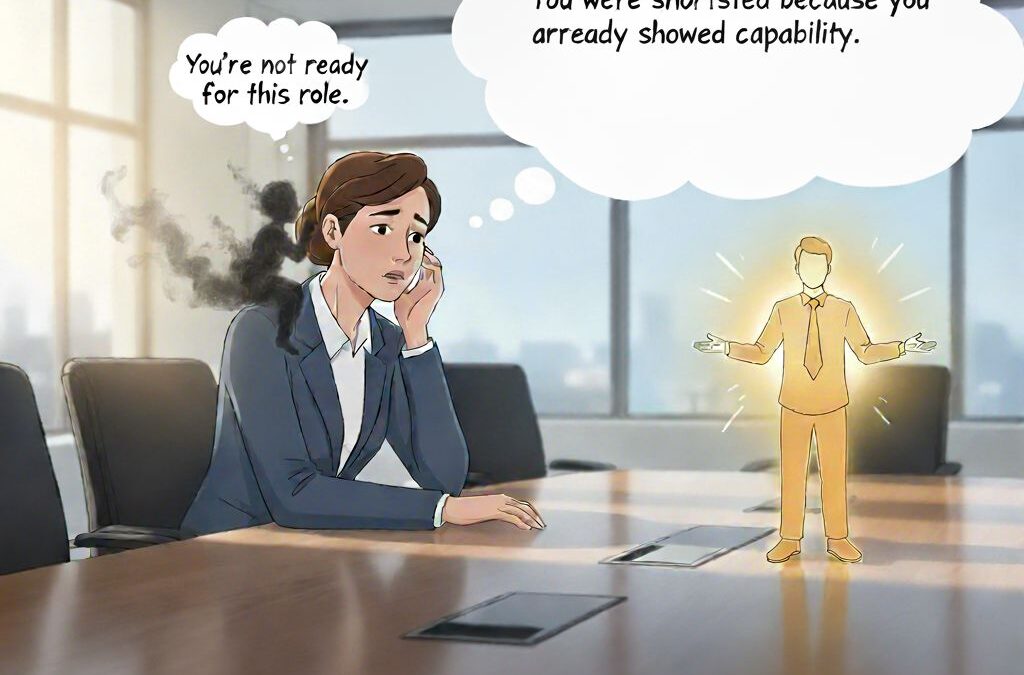
That little voice whispering, “You’re not ready for this role” … sound familiar?
Imposter syndrome often strikes hardest in the days leading up to an interview. It doesn’t matter whether you’re going for an APS3 graduate role or stepping up into an APS6 or EL1 leadership position—that self-doubt creeps in.
The good news? Feeling like an imposter doesn’t mean you are one. In fact, many high achievers—including APS leaders—experience the same inner critic.
Why Imposter Syndrome Shows Up Before Interviews
Interviews are high-stakes moments. You’ve already been through a rigorous selection process—shortlisting, application checks, and sometimes capability assessments. When you finally receive the interview invitation, your brain flips into survival mode.
It says:
- “What if they realise I don’t belong here?”
- “What if I can’t answer their behavioural questions?”
- “What if I fail?”
But here’s the truth: you were shortlisted because you have already demonstrated the required capabilities. Your written application showed evidence against the APS capability framework. The panel has already said “yes” on paper.
Reframing the Interview
One of the biggest mindset shifts I teach my clients is this:
👉 The interview isn’t a test of worthiness.
👉 It’s simply confirmation of what you’ve already demonstrated.
The panel is not looking to trip you up—they’re looking for alignment. They want you to succeed because it means their recruitment process worked. If you want deeper guidance, explore our APS Interview Coaching services.
When imposter thoughts surface, try reminding yourself:
“They’ve already seen I can do the job. Now I just need to let them see it in person.”
Practical Strategies to Quiet the Inner Critic
1. Anchor Yourself in Preparation
Build confidence through STAR-L examples (Situation, Task, Action, Result, and Learning). Preparing 2–3 solid examples for each APS Integrated Leadership System capability ensures you’ll have the right stories ready.
2. Normalise the Nerves
Almost every candidate—yes, even SES executives—feels nervous before interviews. Instead of fighting it, see nerves as energy. Channel it into enthusiasm when you speak.
3. Evidence File Technique
Keep a personal “evidence file.” Record achievements, feedback from managers, or metrics from projects. Reviewing this before your interview reminds you of the tangible value you bring.
4. Replace Doubt With Data
Imposter thoughts are emotional. Combat them with facts:
- “I was shortlisted from 100+ applications.”
- “My application highlighted measurable outcomes—reduced errors by 20%, improved stakeholder engagement, led a project team.”
- “I’ve already proven my value once.”
5. Use Positive Interview Rituals
Simple actions—breathing exercises, power poses, or rehearsing your opening introduction—can shift your state. These small rituals signal to your brain: “I’m ready.”
A Final Mindset Reframe
Remember: you don’t need to be perfect in the interview—you need to be authentic. The APS values integrity, collaboration, and resilience just as much as technical skills.
So the next time imposter syndrome whispers, try saying:
“I’m not here by accident. They’ve already said yes to me on paper. This interview is simply the final step to show them what they already believe—I can do this job.”
✅ Want to go deeper? Book a coaching session today or comment “ready” below, and I’ll share the exact mindset shifts I use with clients to quiet imposter syndrome before APS interviews.
#apsjobs #australianpublicservice #interviewtips #impostersyndrome #interviewconfidence