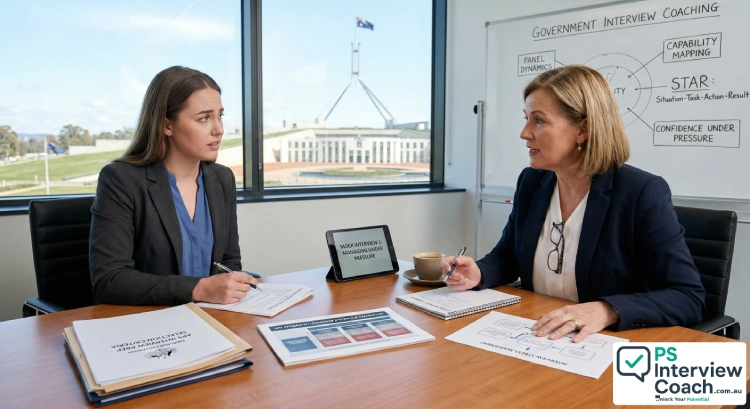
by APS Interview Coach | Feb 28, 2026 | APS Interview Coaching, High Pressure Government Interviews
The Direct Answer: To master high-pressure government interviews, seek coaching from former APS or State Government hiring managers who specialise in the Merit Principle and capability frameworks. Effective coaching must include mock interview simulations and training in the STAR method (Situation, Task, Action, Result) to provide the evidence-based responses panels require.
Securing a role in the public service is one of the most rewarding career moves you can make — but it is also one of the most competitive. Government interviews are not like anything you will encounter in the private sector. They are structured, scored, and conducted under strict merit-based principles that leave little room for vague or unprepared answers.
Whether you are applying for an APS3 entry-level position or an EL2 senior leadership role, the interview panel is evaluating you against a defined set of capabilities. Knowing what those are, how to address them, and how to perform under pressure is the difference between a conditional offer and a rejection letter. This guide covers everything you need to know.
Why Government Interviews Are Different
The single biggest mistake candidates make is treating a government interview like a private sector one. In the private sector, interviews often reward personality, cultural fit, and enthusiasm. In government, those qualities matter far less than your ability to demonstrate evidence of past behaviour mapped directly to the role’s capability requirements.
Government panels assess candidates based on the principle that past behaviour is the best predictor of future performance. Every question you are asked is deliberately designed to draw out a specific example from your experience. The panel is not looking for what you think you would do — they want to know what you have already done, how you did it, and what the outcome was.
Additionally, government interviews are conducted under the Australian Public Service Merit Principle, which means every candidate must be assessed consistently against the same criteria. Panels use scoring sheets, and every response you give is being evaluated in real time. There is no room for waffle, generalisation, or theoretical answers.
Understanding Capability Frameworks
Before you walk into any government interview, you need to understand the capability framework your target agency uses. These frameworks define the behaviours, skills, and attributes expected at each level of the public service.
At the Federal level, the Integrated Leadership System (ILS) outlines capabilities across five core clusters: Shapes Strategic Thinking, Achieves Results, Cultivates Productive Working Relationships, Exemplifies Personal Drive and Integrity, and Communicates with Influence. Each of these clusters has specific descriptors that shift in complexity depending on whether you are applying at the APS4, APS6, EL1, or EL2 level.
State governments use their own frameworks. For example, the NSW Public Sector uses the NSW Capability Framework, Victoria uses the Victorian Public Sector Capability Framework, and Queensland uses the Leadership Competencies for Queensland. Each has its own language, structure, and level descriptors. Applying for a state role without understanding the relevant framework puts you at an immediate disadvantage.
The practical implication of this is significant: you cannot rely on a one-size-fits-all set of interview answers. Your responses must be deliberately mapped to the specific capabilities being assessed for the specific role you are applying for.
Mastering the STAR Method
The STAR method — Situation, Task, Action, Result — is the foundation of all evidence-based government interview responses. Understanding it conceptually, however, is very different from being able to deliver it fluently under pressure in front of a three-person panel.
Situation sets the scene. You need to provide just enough context for the panel to understand the environment you were operating in — the organisation, the team size, the challenge or opportunity at hand. Keep this section brief. Many candidates spend too long here and run out of time before reaching the parts that matter most.
Task clarifies your specific role. This is where many candidates lose marks by being vague. The panel needs to understand exactly what you were personally responsible for, not what your team was doing. Government panels are specifically trained to probe for whether a response is genuinely individual or whether the candidate is borrowing credit from a group effort.
Action is the most critical section and should occupy the majority of your answer. This is where you describe what you specifically did, step by step, decision by decision. Use “I” statements consistently — “I identified,” “I escalated,” “I negotiated,” “I drafted.” Avoid “we” language unless you are explicitly describing a collaborative moment and immediately following it with your individual contribution to that collaboration.
Result closes the loop. Quantify the outcome wherever possible. Numbers, percentages, timeframes, and tangible deliverables all strengthen a result. If the outcome was qualitative — for example, an improvement in team morale or a strengthened stakeholder relationship — describe how you measured or observed that improvement.
Advanced STAR for Senior Roles
For APS6, EL1, and EL2 roles, basic STAR is not sufficient. At these levels, panels expect you to demonstrate strategic thinking, political acumen, and leadership under ambiguity. Your examples need to reflect complexity — situations with competing priorities, sensitive stakeholder dynamics, limited resources, or significant organisational risk.
Advanced STAR involves layering your answers to show not just what you did, but why you made the decisions you made, what alternatives you considered and rejected, and how you brought others along with you. It also means being prepared to handle follow-up probe questions such as “What would you have done differently?” or “How did you manage the stakeholder who disagreed with your approach?”
Senior candidates should also be prepared for hypothetical scenario questions, which are increasingly used alongside behavioural questions at EL level interviews. These questions test your reasoning and judgment in real time, not just your ability to recall past examples.
Preparing Your Example Bank
One of the most effective preparation strategies is to build a personal example bank before your interview. This is a curated set of six to ten strong work examples drawn from your career that can be adapted to answer a wide range of capability-based questions.
When building your example bank, aim for examples that demonstrate complexity and impact. Avoid examples where you were simply following instructions or completing routine tasks — these rarely score well against mid-to-senior level capability descriptors. Instead, prioritise examples where you exercised judgment, managed conflict, led change, influenced without authority, or delivered results in difficult circumstances.
Once you have your examples, map each one to the capabilities in the role’s position description. Identify which capabilities each example best demonstrates, and look for any capability gaps — areas where you do not yet have a strong example prepared. Then work to either develop a new example from your experience or strengthen an existing one to fill that gap.
Performing Under Pressure: What High-Pressure Panels Actually Look Like
Government interview panels are often described by candidates as intimidating — and there is good reason for that. A typical panel consists of two to four interviewers, one of whom acts as the chair. Questions are delivered formally, often read directly from a prepared question script. Panel members take notes throughout. Eye contact can feel clinical. The environment is deliberately structured to be fair, not comfortable.
For many candidates, the pressure comes not just from the panel itself but from the awareness that they are being scored in real time. Knowing that every pause, every tangent, and every vague response is potentially costing them points creates a level of anxiety that is hard to replicate in low-stakes preparation.
The best way to address this is through repeated mock interview practice under realistic conditions. This means sitting across from another person, answering questions out loud, being timed, and receiving structured feedback. Practising in your head or writing out answers is useful but insufficient on its own. The physical and psychological experience of being observed and questioned is something you need to rehearse, not just plan for.
Managing Nerves and Thinking Time
It is entirely acceptable — and often viewed positively — to take a brief moment to gather your thoughts before answering a question. A simple phrase such as “That is a great question, let me take a moment to give you the best example” signals composure and confidence, not hesitation. Panels are experienced interviewers; they know the difference between a candidate who is nervous and one who is thoughtful.
If you lose your train of thought mid-answer, do not panic. Pause, take a breath, and briefly re-anchor yourself: “To bring that back to the result…” or “The key outcome of that action was…” These bridging phrases help you recover your structure without derailing the entire response.
If you genuinely cannot think of a strong example for a particular question, it is better to briefly acknowledge the limitation and pivot to the closest relevant example than to fabricate or over-inflate a weak one. Panels are skilled at probing, and an inflated example will collapse quickly under follow-up questioning.
Common Mistakes That Cost Candidates the Role
Understanding what not to do is just as valuable as knowing what to do. These are the most frequent errors that hiring managers report seeing in government interviews:
- Using “we” instead of “I”: Group-based answers fail to demonstrate individual capability. The panel is assessing you, not your team.
- Describing processes instead of actions: Saying “our team would escalate issues to the manager” describes a process. Saying “I identified a risk, prepared a one-page brief, and escalated directly to the Deputy Secretary within 24 hours” describes an action. Panels want actions.
- Omitting the result: Many candidates give strong Situation, Task, and Action components but then trail off with a vague conclusion. Always close with a concrete outcome.
- Over-preparing generic examples: Memorised answers that have not been tailored to the specific capability descriptors of the role often feel rehearsed and hollow. Panels can tell when an answer has been copy-pasted from a script versus genuinely recalled from experience.
- Failing to demonstrate the right level: An APS6 candidate telling APS3-level stories, or an EL1 candidate who cannot describe strategic leadership, will not score well regardless of how well structured their answers are. Your examples must reflect the complexity expected at your target level.
- Neglecting to research the agency: Government panels often include questions about why you want to work for their specific agency. Vague answers about “wanting to serve the community” are unconvincing. Know the agency’s strategic plan, current priorities, and recent initiatives.
What to Look for in a Government Interview Coach
Not all interview coaching is equal, and for government roles specifically, the gap between a generalist career coach and a specialist public sector coach is significant. When evaluating coaching providers, look for the following:
1. Former Hiring Manager Experience
Coaches who have previously sat on government interview panels bring a fundamentally different perspective to preparation. They know exactly how scoring sheets work, what distinguishes a three out of five response from a five out of five response, and which “red flags” cause panels to immediately discount an otherwise strong candidate. This insider knowledge is not something that can be replicated from reading interview guides or studying capability frameworks from the outside.
2. Jurisdiction-Specific Knowledge
High-pressure coaching must be tailored to the level and jurisdiction you are targeting. Federal APS roles emphasise strategic policy, leadership of systems, and ministerial environment awareness. State government roles often have a stronger operational service delivery focus. Local government interviews have their own community-orientation expectations. A coach who does not understand these distinctions will give you advice that is generic at best and actively misleading at worst.
3. Structured Mock Interview Sessions
Reading about interview technique is useful. Being coached through it in a live mock interview environment is transformative. Look for providers who offer real-time mock interview simulations with immediate, specific feedback — not just a debrief at the end, but in-session guidance that helps you understand in the moment where your answer succeeded and where it fell short.
4. Tailored Example Development
The best coaches do not just tell you what to say — they help you excavate and articulate the genuine strengths already present in your experience. A strong coach will work through your career history with you, identify your highest-value examples, and help you structure and refine them to align precisely with the capability descriptors of your target role.
5. Ongoing Support Through the Process
Government recruitment processes can be lengthy and involve multiple stages — written applications, work sample exercises, psychometric testing, and interviews. Look for a coaching provider who can support you across the full process, not just in the 48 hours before your interview.
How Many Sessions Do You Need?
This depends heavily on your starting point and the seniority of the role. For candidates with some interview experience applying at APS3 to APS5 levels, two to three focused sessions is typically sufficient to sharpen technique and build confidence. For candidates applying at APS6 to EL1 level, or for those who have previously been unsuccessful in government interviews, three to five sessions allows enough time to thoroughly develop your example bank, practice across a range of question types, and address specific weaknesses. EL2 and SES candidates are navigating the most complex interview environments and often benefit from a more extended engagement that includes scenario-based preparation and leadership narrative development.
The most important thing is not the number of sessions but the quality of practice between them. Coaching works when candidates take the feedback seriously, rework their examples, and come back prepared to test the improvements.
Final Preparation: The Week Before Your Interview
In the final week before your interview, your focus should shift from developing new material to consolidating and rehearsing what you already have. Re-read the position description and identify the three to five capabilities most likely to be assessed. Review your example bank and confirm you have a strong, tailored story for each. Practice delivering your answers out loud — ideally with another person, but even solo practice in front of a mirror or recording yourself on your phone provides valuable feedback.
Research the agency’s current strategic priorities. Check their website, recent ministerial statements, and any publicly available annual reports. Being able to reference current agency priorities naturally in your answers signals genuine interest and organisational awareness.
On the day itself, arrive early, dress professionally, and remember that composure is itself a form of evidence. Government panels are assessing your ability to operate effectively under pressure — and how you carry yourself from the moment you enter the room is part of that assessment.
Ready to Excel in Your Government Interview?
Working with a coach who has sat on the other side of the interview table is the most direct path to understanding exactly what government panels are looking for — and how to give it to them. Our team of former APS and State Government hiring managers provides tailored, high-impact coaching for candidates at every level of the public sector.
View Coaching Packages | Book a Free Consultation
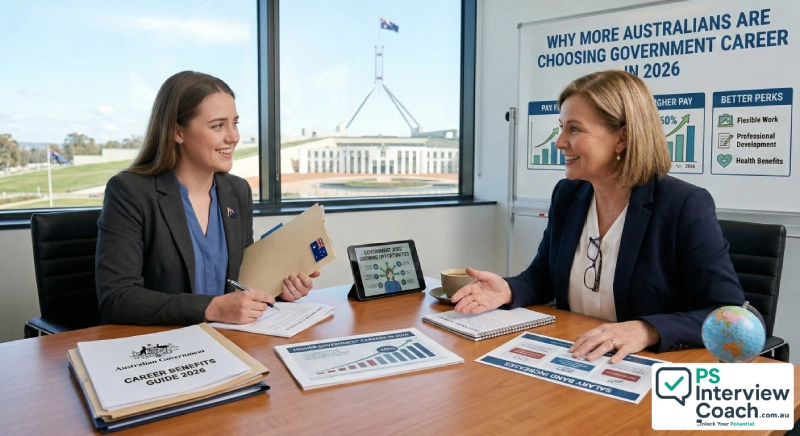
by APS Interview Coach | Feb 21, 2026 | Public Service News
For the first time in a generation, a government job might actually pay better than its private sector equivalent — and the numbers are starting to show it.
Public sector wage growth in Australia is now outpacing that of the private sector. What was once an accepted trade-off — lower pay in exchange for stability and work-life balance — is quietly becoming an outdated idea. If you’ve been sitting on the fence about pursuing a career in the Australian Public Service, this shift in the landscape is worth paying attention to.
A Reversal of the Traditional Norm
Historically, private sector workers commanded a wage premium — particularly in industries like mining, finance, and professional services. The unspoken deal for public servants was simple: accept a little less pay and get security, flexibility, and a healthy super contribution in return.
That deal has changed. Recent enterprise agreements across federal and state public services have locked in strong, predictable pay rises, in part to address the wage stagnation that accumulated during the low-inflation years. Meanwhile, private sector wage growth — while recovering — remains uneven. Some industries are surging; many others are still catching up.
The result? In a growing number of roles and classifications, the APS is now the better-paying option.
It’s Not Just About the Salary
Wages are only one part of the picture. The total value of a public service role has always included things the private sector struggles to match:
- Job security — particularly valued in uncertain economic times
- Flexible and hybrid working arrangements — embedded into enterprise agreements, not left to manager discretion
- Generous superannuation — many APS employees still benefit from defined benefit or above-standard super arrangements
- Leave entitlements — including generous personal leave, study leave, and long service leave conditions
- Meaningful work — the chance to contribute to policy, public programs, and outcomes that affect the whole country
When you add a competitive salary on top of all of that, the case for public service becomes genuinely compelling.
What This Means for the Competition
Here’s the practical reality: more people are paying attention to public sector roles, and that means recruitment processes are becoming more competitive.
The APS was already known for a rigorous, structured selection process — one that’s quite different from private sector hiring. Applicants are assessed on behavioural evidence, the STAR method, the APS Work Level Standards, and the Integrated Leadership System. A strong CV alone won’t get you across the line.
As the talent pool drawn to government roles grows, the standard of applications will rise. The candidates who prepare thoroughly — who understand how to respond to selection criteria, how to pitch their experience in the language of the APS, and how to perform well in structured interviews — will be the ones who succeed.
There Has Never Been a Better Time to Invest in Yourself
The opportunity in front of you right now is real. A well-paid, secure, and deeply rewarding government career is within reach — but only if you show up to the process prepared. And that’s exactly where professional coaching makes all the difference.
Think about what’s at stake: a role with a strong salary, rock-solid job security, meaningful work, and conditions that genuinely support a great quality of life. Investing in professional public sector interview coaching isn’t an expense — it’s a career decision that pays for itself many times over the moment you land the role.
The candidates who succeed in APS recruitment aren’t always the most experienced. They’re the ones who understand the process, know how to structure their responses, and can clearly articulate the value they bring — in the language the selection panel is listening for. That’s a skill, and like any skill, it can be learned and sharpened with the right guidance.
Whether you’re new to government, looking to move up the classifications, or eyeing an SES-level opportunity, our coaching packages are designed to meet you where you are and get you where you want to be.
Is a Public Service Career Right for You?
If you’ve been considering a move into the APS — or a promotion within it — the current environment is arguably the most favourable it’s been in years. The pay gap that once gave people pause is narrowing or has reversed entirely in many classifications. The working conditions remain strong. And the opportunity to do genuinely meaningful work at a national level is real.
But wanting the role and getting the role are two very different things. The APS selection process rewards preparation, and it rewards people who can clearly articulate what they’ve done, how they’ve done it, and what impact they’ve had.
That’s exactly what we help with at PS Interview Coach.
Ready to Make Your Move?
The window is open. Public sector salaries are strong, the lifestyle benefits are unmatched, and a rewarding government career is a very achievable goal — for the right candidate, prepared the right way.
Don’t leave it to chance. View our coaching packages and pricing and take the first step toward the public service career you’ve been working toward. The investment you make in yourself today is the career you’ll be proud of tomorrow.
👉 See our coaching packages and pricing here.
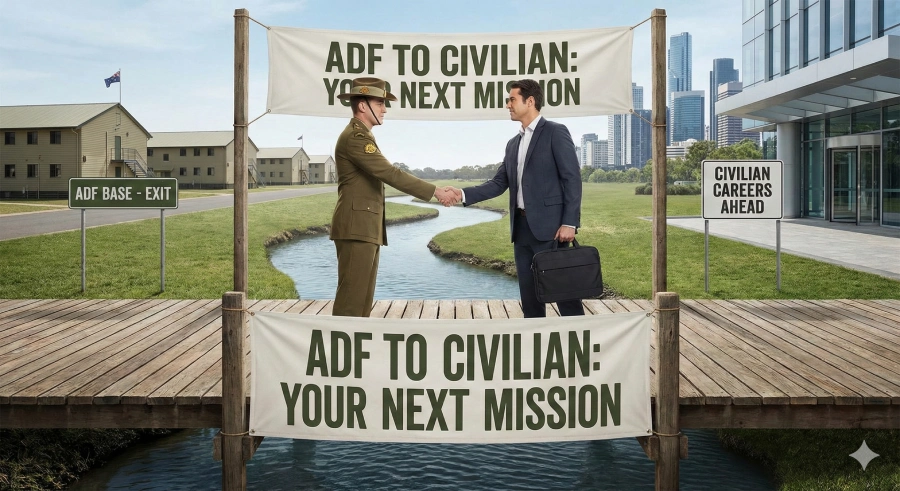
by APS Interview Coach | Feb 1, 2026 | ADF Career Transition Support
Your ADF to Civilian Career Transition: Why Experience Matters When Choosing Your Coach
Written by former Defence employees who’ve walked the path you’re about to take
After years of dedicated service in the Australian Defence Force, the transition to civilian life represents one of the most significant career changes you’ll ever make. It’s not just about finding a new job—it’s about translating your military experience into civilian language, understanding a completely different workplace culture, and navigating recruitment processes that bear little resemblance to ADF career progression.
Our Veteran Career Support Transition Program
At PS Interview Coach, we understand this transition intimately because we’ve lived it. With over 40 years of combined government and Defence experience, including roles across the Australian Public Service (APS), Department of Defence, DFAT, and other military-linked agencies, we’re uniquely positioned to guide your transition from uniform to civilian career success.
The Reality of ADF Career Transition: More Than Just a Job Search
If you’re currently serving or recently discharged from the ADF, you already know that military service develops exceptional skills: leadership under pressure, strategic thinking, adaptability, teamwork, and an uncompromising commitment to excellence. You’ve managed complex operations, led diverse teams, made critical decisions with incomplete information, and maintained composure in high-stress environments.
Yet despite these strengths, many ADF members struggle with career transition. Why?
The Hidden Challenges Veterans Face
1. The Translation Gap
Military achievements don’t always translate directly to civilian selection criteria. Your experience commanding a section of 10 personnel in challenging conditions is leadership gold—but how do you articulate it in a way that resonates with APS hiring panels who’ve never worn a uniform?
2. Different Selection Processes
ADF promotion boards assess potential differently than civilian interview panels. The APS uses structured behavioural interviews, written applications addressing specific selection criteria, and competency frameworks that may seem foreign after years in Defence.
3. Cultural Adjustment
The direct communication style valued in military settings can be misinterpreted in civilian workplaces. Understanding nuanced civilian workplace dynamics, stakeholder management, and the less hierarchical nature of many APS roles requires guidance.
4. Imposter Syndrome
Many veterans question whether their skills are “relevant” in civilian roles, despite having led in more demanding situations than most civilian managers will ever face. This self-doubt can undermine otherwise strong applications and interviews.
5. The Civilian Recruitment Process
From STAR method responses to addressing selection criteria, civilian recruitment has its own language and expectations. Without insider knowledge, even highly qualified veterans can be screened out before they reach the interview stage.
Why Your Transition Coach’s Background Matters
Career coaching isn’t one-size-fits-all, and this is especially true for ADF transition. The difference between a coach who understands military service and one who doesn’t is substantial.
What Generic Career Coaches Miss
Well-meaning career advisers without military or government backgrounds often:
- Undervalue military experience: They don’t recognise how your section commander role translates to high-level civilian leadership, or how your operational planning experience applies to strategic project management
- Misunderstand the APS: They give generic advice that doesn’t account for the unique culture, values, and recruitment practices of government departments
- Overlook veteran advantages: They fail to leverage the respect and value that Defence experience carries within government agencies
- Apply civilian frameworks incorrectly: They don’t know how to bridge military achievements with APS competency frameworks in authentic, compelling ways
- Miss insider opportunities: They’re unaware of veteran-specific pathways, Defence-linked roles, and government positions that actively value military backgrounds
The PS Interview Coach Difference: Lived Experience
At PS Interview Coach, our founders—Chris and the team—are former Defence employees ourselves. We’ve made the exact transition you’re contemplating. We’ve sat on both sides of the table: as transitioning veterans navigating civilian recruitment, and as government hiring managers assessing candidates.
This dual perspective is invaluable because we can:
- Speak your language: We understand military terminology, rank structures, and the context of your achievements
- Translate effectively: We know exactly how to reframe your military experience for civilian hiring panels
- Navigate APS culture: With 40+ years across government departments including Defence, DFAT, and ASD, we understand the unwritten rules, cultural expectations, and what different agencies value
- Leverage insider knowledge: We know which departments actively seek veterans, which roles suit military backgrounds, and how to position you competitively
- Provide realistic guidance: We offer honest assessments of role suitability, realistic timelines, and strategic career advice based on actual government experience
- Offer genuine empathy: We’ve felt the uncertainty, the cultural adjustment, and the challenge of proving yourself in a new environment
High-Value Civilian Career Paths for ADF Veterans
Your military background is particularly valuable in specific government sectors. Based on our experience, here are the most natural and rewarding transition paths:
1. Department of Defence (Civilian Roles)
Defence actively values military experience in civilian positions. Your understanding of military culture, operations, and organisational structure gives you a significant advantage.
Ideal Roles:
- Project managers for Defence capability programs
- Strategic policy advisers
- Operations and logistics coordinators
- Defence industry liaison roles
- Military capability analysts
- Training and doctrine development
Why You’re Suited: You already understand Defence priorities, culture, and stakeholders. You can work effectively with serving members and understand operational requirements in ways civilian-only employees cannot.
2. Australian Signals Directorate (ASD)
ASD and intelligence agencies highly value the security clearances, operational experience, and disciplined approach that ADF members bring.
Ideal Roles:
- Intelligence analysts
- Cyber security specialists
- Operational support roles
- Strategic planning and assessment
- Technical project management
Why You’re Suited: Your existing security clearance, understanding of operational security, and experience managing sensitive information are significant assets.
3. Department of Foreign Affairs and Trade (DFAT)
DFAT values the international experience, cultural awareness, and strategic thinking that ADF service develops, particularly for those with deployment experience.
Ideal Roles:
- Defence and strategic policy advisers
- International security specialists
- Consular operations
- Trade and investment roles (particularly in defence industry)
- Regional security analysis
Why You’re Suited: Deployment experience, cross-cultural competence, and strategic awareness make you valuable for international roles.
4. Australian Submarine Corporation & Defence Industry
The expanding defence industry, particularly around submarine capability, actively recruits veterans for technical and project management roles.
Ideal Roles:
- Program and project managers
- Technical specialists and engineers
- Supply chain and logistics managers
- Quality assurance and compliance
- Training and capability development
Why You’re Suited: Understanding of military requirements, technical knowledge, and project discipline are essential in defence industry.
5. Home Affairs & Border-Related Agencies
Australian Border Force, immigration, and security agencies value operational experience, decision-making under pressure, and security awareness.
Ideal Roles:
- Border operations and enforcement
- Intelligence and risk assessment
- Compliance and investigation roles
- Emergency management and response
- Strategic security planning
Why You’re Suited: Operational discipline, security clearance, and ability to make sound decisions under pressure are core requirements.
6. Emergency Management & Resilience Agencies
State and federal emergency management agencies recognise that military experience is excellent preparation for crisis coordination and disaster response.
Ideal Roles:
- Emergency operations coordinators
- Crisis management planners
- Logistics and resource management
- Training and exercise development
- Strategic resilience planning
Why You’re Suited: Experience coordinating complex operations, managing under pressure, and working with diverse stakeholders translates directly.
7. Broader APS Leadership & Management
Your leadership experience is valuable across the entire public service, from operational management to strategic policy development.
Ideal Roles:
- Program and project managers across any portfolio
- Team leaders and middle management
- Strategic planning and policy officers
- Organisational change and transformation specialists
- Governance and risk management
Why You’re Suited: Leadership, strategic thinking, and ability to deliver under constraints are universally valued APS competencies.
Translating Your ADF Experience: Real Examples
One of the most critical aspects of successful transition is learning to “translate” your military achievements. Here’s how we help veterans reframe their experience:
Example 1: Section Commander to APS Team Leader
Military Experience:
“Section Commander, 2nd Battalion. Commanded 10 personnel during Operation [X], maintaining operational readiness and achieving all mission objectives in a high-threat environment.”
Civilian Translation:
“Led a geographically dispersed team of 10 professionals in a high-pressure operational environment requiring 24/7 response capability. Developed team capabilities through structured training and mentoring, achieving 100% operational readiness targets while maintaining team wellbeing and morale. Managed complex stakeholder relationships and coordinated resources across multiple agencies to deliver critical outcomes under tight timeframes and resource constraints.”
Why It Works: Emphasises leadership, team development, stakeholder management, and delivery under pressure—all key APS competencies—while removing military-specific jargon.
Example 2: Operations Officer to Strategic Project Manager
Military Experience:
“Operations Officer, deployed to [location]. Planned and coordinated multi-unit operations, managed logistics, and maintained operational security.”
Civilian Translation:
“Managed complex, multi-stakeholder projects involving coordination across 5+ organisational units and external partners. Developed strategic plans, allocated resources efficiently, and maintained rigorous risk management and security protocols. Delivered critical outcomes within strict budget and timeline constraints while adapting to rapidly changing operational requirements. Managed sensitive information in accordance with strict governance frameworks.”
Why It Works: Highlights project management, strategic planning, risk management, and stakeholder coordination in civilian-friendly language.
Example 3: Training Instructor to Learning & Development Specialist
Military Experience:
“Qualified instructor at [School]. Delivered technical and leadership training to junior and senior personnel. Developed training materials and assessed competency.”
Civilian Translation:
“Designed and delivered comprehensive capability development programs for diverse audiences ranging from entry-level staff to senior leaders. Conducted needs analysis, developed evidence-based training frameworks, and assessed participant competency against defined standards. Continuously improved program effectiveness through feedback analysis and alignment with organisational objectives, achieving 95% participant satisfaction ratings.”
Why It Works: Reframes training expertise using learning and development terminology while emphasising assessment, continuous improvement, and stakeholder satisfaction.
The Critical Components of Successful ADF Transition
Based on our experience supporting dozens of veterans into civilian government roles, successful transition requires support in four key areas:
1. Strategic Career Planning
Not all government roles are created equal, and not all are ideal fits for your particular military background. We help you:
- Identify roles that genuinely align with your experience and career goals
- Understand which departments and agencies actively value military backgrounds
- Assess realistic salary expectations and classification levels
- Map short-term and long-term career pathways in the APS
- Leverage your existing security clearance and networks strategically
- Identify skills gaps and professional development opportunities
2. Application Writing & Selection Criteria
APS applications require addressing selection criteria—often 4-8 specific statements demonstrating your capability against role requirements. This is where many veterans stumble, either underselling their achievements or using language that doesn’t resonate with civilian panels.
We provide:
- Expert selection criteria writing services
- Translation of military experience to civilian competency frameworks
- Guidance on which experiences best demonstrate required capabilities
- Review and refinement to ensure applications are competitive
- Strategic advice on tailoring applications to specific agencies
3. Interview Preparation & Coaching
APS interviews follow structured behavioural formats, typically using the STAR method (Situation, Task, Action, Result). Panels assess against defined competencies, and responses must provide specific examples with measurable outcomes.
Our interview coaching includes:
- Training on the STAR framework and how to structure compelling responses
- Development of 8-12 strong examples from your military experience
- Translation of these examples into civilian-appropriate language
- Mock interviews with feedback from former APS hiring managers
- Guidance on presentation, communication style, and panel dynamics
- Preparation for common veteran-specific questions and concerns
- Strategies for addressing employment gaps or medical discharge sensitively
4. Cultural Integration & Workplace Adjustment
The transition isn’t over when you accept the job offer. Understanding and adapting to civilian workplace culture is essential for long-term success.
We provide guidance on:
- APS values, ethics, and code of conduct expectations
- Navigating less hierarchical workplace structures
- Adapting communication styles for civilian contexts
- Building relationships and networks in government
- Understanding APS performance management and promotion pathways
- Managing the emotional aspects of transition and identity shift
Common Mistakes Veterans Make (And How to Avoid Them)
Through our work with transitioning ADF members, we’ve identified recurring mistakes that cost veterans opportunities:
Mistake 1: Using Military Jargon and Acronyms
The Problem: Applications and interviews filled with military terminology that civilian panels don’t understand (or must constantly Google).
The Solution: Translate every military term into civilian language. Instead of “OC of Bravo Company,” say “senior manager responsible for 120 personnel.” Instead of “conducted BPT for Operation [X],” say “developed contingency plans for critical operations.”
Mistake 2: Underselling Achievements
The Problem: Military culture values humility and team success. Many veterans downplay their individual contributions or fail to quantify achievements.
The Solution: APS applications and interviews require clear articulation of YOUR specific actions and measurable outcomes. It’s not boasting—it’s evidence of capability. We help you strike the right balance.
Mistake 3: Focusing on Technical Skills Over Leadership
The Problem: Veterans often emphasise technical qualifications (trade certifications, operational skills) while undervaluing their leadership, strategic thinking, and people management experience.
The Solution: Most APS roles value leadership and strategic capabilities above technical skills. We help you reframe your experience to emphasise these higher-value competencies.
Mistake 4: Applying for Roles Too Junior for Their Experience
The Problem: Uncertainty about civilian classification levels leads many veterans to apply for roles well below their capability, effectively taking pay cuts and underselling themselves.
The Solution: Understanding APS classification levels and which align with your military rank and experience. A Warrant Officer or Senior NCO often maps to APS6 or EL1 roles, not APS3-4. We provide realistic assessments.
Mistake 5: Not Leveraging Existing Networks
The Problem: Veterans often don’t realise the value of their existing Defence and veteran networks in identifying opportunities and getting insider referrals.
The Solution: Strategic networking advice, including how to leverage LinkedIn, veteran employment programs, and Defence connections ethically and effectively.
Mistake 6: Inadequate Preparation for Civilian Interview Format
The Problem: Assuming military promotion board experience prepares you for APS behavioural interviews. It doesn’t—the format, expectations, and assessment criteria are fundamentally different.
The Solution: Comprehensive interview coaching specifically designed for veterans, addressing both the technical format and the cultural adjustment required.
Mistake 7: Ignoring Selection Criteria or Treating Them Casually
The Problem: Submitting a standard resume instead of addressing each selection criterion comprehensively, or providing generic responses that could apply to anyone.
The Solution: Treating each selection criterion as a mini-essay requiring specific examples, clear structure, and evidence of capability. Generic applications are eliminated before reaching interview stage.
Your Security Clearance: A Valuable Asset
If you hold an active security clearance (NV1, NV2, PV, TSPV), you possess a significant competitive advantage that many civilians don’t have. Security clearances can take 6-18 months to obtain and cost employers tens of thousands of dollars.
How to Leverage Your Clearance:
- Highlight it prominently in your resume and applications
- Understand expiry timelines and seek roles before clearance lapses
- Target positions requiring clearance where your advantage is maximised
- Maintain your clearance even if initially pursuing unclassified roles
- Emphasise your understanding of security protocols and information management
Many veterans don’t realise that clearance alone can move them to the top of the shortlist for security-focused roles in Defence, ASD, intelligence agencies, and other classified environments.
Special Considerations for Medical Discharge & DVA Support
If you’re transitioning due to medical discharge or managing service-related injuries, additional considerations apply:
Managing Disclosure Appropriately
You’re not required to disclose medical conditions unless they affect your ability to perform essential role functions. We help you:
- Understand what must be disclosed and what’s private
- Frame service-related challenges positively where relevant
- Request reasonable workplace adjustments without undermining your application
- Navigate questions about employment gaps or early discharge sensitively
DVA Support Programs
Veterans may be eligible for:
- Career transition assistance and training funding through DVA
- Priority consideration in APS recruitment (for eligible veterans)
- Mentoring and support programs
- Workplace adjustment funding for adaptive equipment or support
We help you navigate these programs and incorporate available support into your transition strategy.
The Emotional Reality of Career Transition
Let’s be honest: leaving the ADF is emotionally challenging, even when it’s the right decision. Military service shapes identity, provides clear purpose, and creates bonds that civilian workplaces rarely replicate.
It’s normal to experience:
- Loss of identity: “Soldier” or “sailor” has been central to who you are for years
- Grief for camaraderie: The bonds formed in service are difficult to find elsewhere
- Uncertainty about purpose: Civilian work can feel less meaningful initially
- Frustration with civilian pace: Things often move more slowly and bureaucratically
- Anxiety about fitting in: Worrying that you won’t adapt or be accepted
- Financial stress: Particularly if transitioning takes longer than expected
Working with coaches who’ve experienced this transition means you’re not just getting technical support—you’re getting empathy, realistic expectations, and reassurance from people who’ve been exactly where you are.
Success Stories: Veterans We’ve Helped Transition
Note: Details modified to protect client confidentiality
Case Study 1: From Infantry Officer to Defence Strategic Policy
Background: Former Army Captain with 12 years’ service, multiple deployments, and command experience. Initially applied for APS4-5 operational roles, unsure of his civilian value.
Our Support: Identified his strategic planning and international experience as ideal for policy roles. Helped develop applications for EL1 positions in Defence strategic policy branch.
Outcome: Secured EL1 role in Defence strategic policy at $40K+ higher than his initial target roles. Now advises on military capability and international engagement—directly leveraging his service experience.
Case Study 2: From Aviation Technician to ASD Technical Specialist
Background: RAAF technical specialist with NV2 clearance, medically discharged after 8 years. Concerned injury would limit opportunities.
Our Support: Emphasised technical expertise, security clearance, and problem-solving abilities. Prepared for behavioural interviews focusing on technical challenges overcome. Addressed medical discharge sensitively without undermining capability.
Outcome: Secured APS6 technical specialist role at ASD within 6 weeks of discharge. Clearance and technical background made him immediately competitive. Workplace adjustments accommodated without issue.
Case Study 3: From Navy Logistics Officer to DFAT Operations
Background: Navy Lieutenant with supply chain and logistics experience, deployment to SE Asia. Wanted international-facing role but unsure how to position military logistics for DFAT.
Our Support: Reframed logistics experience as program management, emphasised cross-cultural competence from deployment, and prepared for DFAT’s competency-based interview process.
Outcome: Secured EL1 position in DFAT operations, managing international programs. Deployment experience and cultural awareness proved decisive factors.
Why Choose PS Interview Coach for Your ADF Transition
The veteran employment support market includes many options: DVA programs, veteran employment agencies, general career coaches, and resume writers. So why choose PS Interview Coach?
1. Genuine Defence & APS Experience
We’re not just coaches who’ve read about Defence—we’re former Defence employees who’ve lived the transition ourselves. Our 40+ years of combined government experience, including time in Defence, DFAT, and other agencies, means we understand both sides of your journey.
2. Insider Knowledge of Government Recruitment
We’ve served on APS hiring panels. We know what they’re looking for, how applications are assessed, what makes a candidate stand out, and what causes immediate elimination. This insider perspective is invaluable.
3. Specialist Focus on Government & Defence-Linked Roles
We don’t try to be everything to everyone. Our specialist focus is government and defence-adjacent roles because that’s where veteran skills are most valued and where we can provide the greatest value.
4. Proven Track Record
We’ve successfully supported dozens of veterans into APS roles across Defence, ASD, DFAT, Home Affairs, and other agencies. Our clients consistently report that our coaching was the difference between rejection and success.
5. Comprehensive Support Beyond Just Interviews
While many services focus only on resume writing or only on interview prep, we provide end-to-end support: career strategy, application writing, interview coaching, and post-placement advice. Your transition is a journey, not a single event.
6. Understanding of Military Culture & Values
We speak your language. We understand the pride of service, the challenge of leaving, and the importance of finding meaningful work that honours your contribution. We also understand the frustrations of dealing with civilian processes that seem inefficient compared to military clarity.
7. Personalised, Not Generic
Every veteran’s experience is unique. We provide personalised coaching based on YOUR specific background, goals, and circumstances—not templated approaches that treat all transitioning members the same.
What to Expect When Working With Us
Our veteran transition support is collaborative and comprehensive:
Initial Consultation (Free)
We start with a free consultation to understand:
- Your military background and service experience
- Your career goals and interests
- Your timeline and constraints
- Your concerns and questions about transition
- How we can best support your specific needs
This consultation is genuinely free with no obligation—we want to ensure we’re the right fit for you as much as you want to assess whether we can help.
Strategic Career Planning Session
Before diving into applications, we develop a clear strategy:
- Identify target roles and departments that align with your background
- Assess realistic classification levels and salary expectations
- Map short and long-term career pathways
- Identify any skills gaps or professional development needs
- Create a structured job search and application timeline
Application Development
For each role you target, we provide:
- Review of position requirements and selection criteria
- Identification of relevant military experiences
- Translation of these experiences into civilian language
- Drafting and refinement of selection criteria responses
- Resume tailoring for government applications
- Cover letter development where required
Interview Preparation
Once you’re shortlisted, we provide comprehensive interview coaching:
- Training on STAR method and behavioural interview frameworks
- Development of 8-12 strong examples from your military experience
- Practice sessions with real-time feedback
- Mock interviews simulating panel format and questioning
- Refinement of communication style and presentation
- Preparation for common veteran-specific questions
- Final preparation session before your interview
Ongoing Support
Even after you’ve accepted a position, we’re available for:
- Onboarding advice and cultural adjustment tips
- Feedback on probation performance and expectations
- Guidance on professional development and APS career progression
- Support for subsequent applications as you advance your career
Investment in Your Future
We understand that transition can be financially stressful, particularly if you’re managing medical discharge or family considerations. However, investing in professional support typically pays for itself many times over through:
- Faster placement: Securing a role in 2-3 months instead of 12+ months
- Higher classification: Starting at EL1 instead of APS6 means $20-30K+ in additional annual salary
- Better role fit: Targeting strategic roles aligned with your experience rather than settling for operational positions
- Reduced stress: Confidence in your applications and interviews eliminates anxiety and false starts
- Career trajectory: Starting at the right level and in the right role sets the foundation for long-term career success
Many of our veteran clients tell us that our coaching was worth 10-20 times the investment when they consider the improved salary outcomes and faster placement.
We offer flexible payment options and can work with DVA funding where applicable. Your dedicated coaching package and pricing will be outlined on our upcoming ADF Transition Coaching page (link to be added).
Frequently Asked Questions from Transitioning Veterans
When should I start my transition preparation?
Ideally, 6-12 months before your intended discharge date. This allows time for strategic career planning, professional development if needed, and a methodical job search. However, we regularly support members who are transitioning immediately—it’s never too late to get expert help.
Will my military rank directly translate to an APS classification?
There’s no exact formula, but general guidelines exist:
- Junior enlisted (PTE-CPL): APS1-3
- Senior NCOs (SGT-WO): APS4-6 or EL1
- Junior Officers (2LT-CAPT): APS6-EL1
- Senior Officers (MAJ-LTCOL): EL1-EL2
- Senior Leadership (COL+): EL2-SES
However, your specific role, responsibilities, and achievements matter more than rank alone. We help you identify the right classification level for your unique experience.
Do I need a degree to work in the APS?
Not always. Many APS roles, particularly operational and technical positions, don’t require tertiary qualifications if you have relevant experience. However, qualifications can help with:
- Meeting essential criteria for some roles
- Competing for higher classification levels
- Long-term career progression to senior leadership
We provide honest assessments of whether additional qualifications would benefit your specific goals and can advise on recognition of prior learning (RPL) programs for veterans.
How long does APS recruitment typically take?
Unfortunately, often 3-6 months from application to job offer. Some agencies are faster, some slower. The process typically includes:
- Application closing and shortlisting: 2-4 weeks
- Interview scheduling: 2-6 weeks
- Interview panel deliberation: 1-2 weeks
- Reference checks: 1-2 weeks
- Security clearance (if required): 0-6 months depending on level
- Final approval and offer: 1-2 weeks
This is why starting early and applying for multiple roles concurrently is advisable.
Will my security clearance transfer?
Yes, security clearances transfer between government agencies and some cleared defence industry roles. However:
- You must maintain your clearance current (some agencies require re-vetting)
- Clearance level must match role requirements (NV1 won’t satisfy a PV requirement)
- Some agencies conduct additional vetting even with existing clearance
What if I was medically discharged?
Medical discharge doesn’t prevent APS employment. Key considerations:
- You must be able to perform essential role functions (with reasonable adjustment if needed)
- Disclosure is only required for conditions affecting role performance
- Many agencies have active diversity and inclusion programs supporting veterans with service-related injuries
- DVA can provide workplace adjustment funding in some cases
We help you navigate this sensitively and strategically.
Can I apply for APS roles while still serving?
Yes, and it’s advisable if you have a known discharge date. This allows you to:
- Secure a role before separation, reducing financial stress
- Time your discharge with your start date
- Maintain career momentum without gaps
Just ensure you can meet the proposed start date and that you’re not using Defence resources (time, equipment) for job searching.
What if I don’t have civilian work experience?
Your military experience IS work experience—it’s just differently structured. Many successful APS employees came straight from Defence with no civilian background. The key is translation, which is exactly what we specialise in.
Take the First Step Toward Your Civilian Career
Transitioning from the ADF to civilian life is challenging, but you don’t have to navigate it alone. With the right support, your military experience becomes a powerful competitive advantage in the government job market.
At PS Interview Coach, we’ve walked the path you’re on. We understand the uncertainty, the cultural adjustment, and the challenge of translating your service into civilian success. More importantly, we know how to help you do it effectively.
Your service has given you skills that civilian employers desperately need: leadership, resilience, strategic thinking, adaptability, and the ability to deliver under pressure. Let us help you communicate that value and secure the civilian career you deserve.
Ready to Start Your Transition?
Book Your Free Consultation →
In this no-obligation session, we’ll:
- Discuss your military background and career goals
- Identify target roles and realistic pathways
- Assess your current application and interview readiness
- Outline how we can support your specific transition needs
- Answer all your questions about APS recruitment and culture
Or explore our services:
About Your Coaches
PS Interview Coach was founded by Chris and team members who are all former Defence and government employees with over 40 years of combined public sector experience. We’ve served in the Australian Defence Force, worked across Defence, DFAT, and other Commonwealth agencies, and successfully transitioned from military to civilian careers ourselves.
We created PS Interview Coach because we saw too many capable, dedicated veterans struggle with transition—not because they lacked skills, but because they lacked the insider knowledge and support to navigate civilian recruitment effectively. We’re committed to changing that, one successful transition at a time.
Our experience includes:
- Active ADF service across Army, Navy, and Air Force
- Civilian roles in Defence, DFAT, ASD, and broader APS
- Serving on government hiring panels and selection committees
- Managing teams of transitioning veterans in government roles
- Supporting dozens of veterans through successful APS transitions
When you work with us, you’re not just getting coaches—you’re getting mentors who genuinely understand your journey because we’ve lived it ourselves.
Our Veteran Career Support Transition Program
PS Interview Coach is Australia’s specialist in public sector recruitment preparation, with particular expertise in supporting ADF veterans transitioning to civilian government careers. We’ve helped hundreds of candidates secure roles with Defence, DFAT, ASD, Home Affairs, and other Commonwealth agencies.
Questions about ADF transition or our coaching services? Email us at info@psinterviewcoach.com.au or call (02) 6106 9669.
Disclaimer: PS Interview Coach is an independent coaching service and is not affiliated with or endorsed by the Australian Defence Force, Department of Defence, or any Commonwealth agency. All information is based on publicly available resources and our professional experience supporting veteran transitions.
by APS Interview Coach | Feb 1, 2026 | Uncategorized
The Complete Guide to AFP Assessment Centres: What to Expect and How to Succeed
Last Updated: February 2026
Landing a role with the Australian Federal Police (AFP) is a significant career achievement, but the journey to get there is rigorous and demanding. The AFP Recruit Assessment Validation Centre (RAVC) is where your preparation meets reality, and many candidates find this stage the most challenging part of the entire recruitment process.
At PS Interview Coach, we’ve helped dozens of candidates successfully navigate AFP assessment centres, and we’re sharing our insider knowledge to help you prepare effectively.
Understanding the AFP Recruitment Journey
Before we dive into the assessment centre specifics, it’s important to understand where it fits in the overall recruitment timeline.
The AFP recruitment process typically takes 6-12 months and consists of seven key gateways:
- Online Application – Your first impression matters
- Online Cognitive Testing – Literacy, numeracy, abstract reasoning, and emotional intelligence
- Entry Physical Competency Assessment (EPCA) – Physical fitness benchmarks
- Employment Suitability Questionnaire (ESQ) – Character and integrity assessment
- Recruit Assessment Validation Centre (RAVC) – The focus of this guide
- Medical & Psychological Assessment – Comprehensive health evaluation
- Security Vetting (NV1) – Extensive background checks covering 10 years
The RAVC typically occurs after you’ve passed the initial screening stages, so reaching this point already demonstrates you’re a strong candidate. However, this is where preparation truly separates successful applicants from those who fall short.
What Happens at the AFP RAVC?
The Recruit Assessment Validation Centre is usually conducted over one to two days at an AFP facility. You’ll be assessed alongside other candidates through multiple exercises designed to evaluate your suitability for policing work.
Key Components of the RAVC
1. Panel Interview (Behavioural Interview)
Expect to face a panel of 3-4 AFP assessors who will ask behavioural questions focused on your past experiences. This typically lasts 45-60 minutes and uses the STAR method framework.
2. Role-Playing Scenarios
You’ll be given realistic policing situations where you must interact with actors playing members of the public. Common scenarios include resolving disputes, managing distressed individuals, handling complaints, or addressing ethical dilemmas. You’ll typically have 5-10 minutes to review the scenario and prepare before a 10-15 minute role-play.
3. Group Exercises
Working with other candidates, you’ll complete team-based tasks while assessors observe your collaboration, communication, and leadership qualities.
4. Written Task
You may be required to write incident reports, recommendations, or professional correspondence demonstrating clear, concise writing skills.
5. Observation Test
Some assessment centres include exercises where you watch videos or examine images and must identify and recall key information.
6. Physical Revalidation
A recheck of physical competency to ensure you’ve maintained fitness standards.
What Assessors Are Really Looking For
Understanding what AFP assessors evaluate is crucial to your preparation. Every exercise at the RAVC assesses your alignment with the AFP Core Values:
The Six AFP Core Values
1. Integrity
- Honesty in all situations
- Moral courage to do what’s right
- Ethical decision-making
- Transparency and accountability
2. Commitment
- Dedication to public service
- Perseverance through challenges
- Going above and beyond
- Continuous professional development
3. Excellence
- High-quality work standards
- Continuous improvement mindset
- Innovation and initiative
- Attention to detail
4. Accountability
- Taking ownership of actions and outcomes
- Learning from mistakes
- Meeting commitments
- Professional responsibility
5. Fairness
- Equitable treatment of all people
- Impartial decision-making
- Respect for diversity
- Cultural sensitivity
6. Trust
- Building confidence with colleagues and community
- Reliability and consistency
- Maintaining confidentiality
- Professional conduct
Every answer you give, every action you take in the assessment centre, should demonstrate these values.
The STAR Method: Your Interview Framework
The behavioural interview questions at the RAVC require structured responses. The STAR method is non-negotiable:
S – Situation (15-20% of your answer)
Set the context briefly. Where were you? What was happening? Keep this concise.
“While working as a retail manager at [Store], we experienced an increase in theft incidents affecting staff morale and store profitability.”
T – Task (10-15% of your answer)
What was your specific responsibility or challenge?
“As the duty manager, I was responsible for addressing both the security issues and the team’s concerns about safety.”
A – Action (50-60% of your answer)
This is the most important part. Detail the specific steps YOU took. Use “I” not “we.”
“I conducted individual conversations with each team member to understand their concerns and gather suggestions. I then researched security solutions within our budget, consulted with our regional security adviser, and presented three options to senior management. I implemented a multi-layered approach including repositioning CCTV cameras, introducing a buddy system for closing procedures, and arranging security awareness training for all staff. I also established a weekly check-in to monitor effectiveness and address ongoing concerns.”
R – Result (15-20% of your answer)
What was the outcome? Use measurable results when possible.
“Over the following three months, theft incidents decreased by 65%, and our staff survey showed a 40% improvement in feelings of safety at work. Two team members who had been considering leaving decided to stay, and the measures I implemented were adopted across three other stores in our region.”
Tips for STAR Success
- Prepare 5-7 diverse stories that cover different competencies
- Each story should be 2-3 minutes when spoken aloud
- Practise out loud, not just in your head
- Don’t memorise word-for-word (you’ll sound robotic)
- Have backup examples in case they ask follow-up questions
- Choose examples that show growth and learning
Common RAVC Interview Questions
While we can’t predict exact questions, here are themes frequently explored:
Integrity & Ethics
- “Tell me about a time you witnessed unethical behaviour. What did you do?”
- “Describe a situation where you had to choose between following rules and helping someone.”
- “Give an example of when you admitted a mistake that had significant consequences.”
Conflict Resolution
- “Tell me about a difficult conversation you had to have with someone.”
- “Describe a time you successfully de-escalated a tense situation.”
- “Give an example of resolving a disagreement between team members.”
Teamwork & Collaboration
- “Tell me about working with a difficult team member.”
- “Describe your role in a successful team project.”
- “Give an example of when you had to compromise for the team’s benefit.”
Resilience & Stress Management
- “Tell me about a time you faced significant pressure. How did you cope?”
- “Describe a situation where you failed and what you learnt.”
- “Give an example of adapting to unexpected change.”
Problem-Solving & Initiative
- “Tell me about a complex problem you solved.”
- “Describe a time you identified an improvement and implemented it.”
- “Give an example of when you had to make a decision with limited information.”
Cultural Awareness & Diversity
- “Tell me about working with people from different backgrounds.”
- “Describe how you adapted your communication for different audiences.”
- “Give an example of challenging bias or discrimination.”
Mastering Role-Play Scenarios
Role-plays catch many candidates off-guard, but they’re highly predictable once you understand the framework.
The Role-Play Structure
Preparation Phase (5-10 minutes)
- Read the scenario carefully (twice)
- Identify the core issue and secondary concerns
- Note relevant policies or values
- Plan your approach
- Take brief notes (you can bring them in)
Execution Phase (10-15 minutes)
Follow this proven structure:
1. Introduction & Rapport Building (1-2 minutes)
- Introduce yourself professionally
- Explain your role
- Create a comfortable environment
- Show respect and empathy
2. Information Gathering (3-4 minutes)
- Ask open-ended questions (“Can you tell me more about…”)
- Practise active listening
- Acknowledge emotions
- Avoid assumptions
3. Summarise & Confirm Understanding (1-2 minutes)
- Reflect back what you’ve heard
- Check for accuracy
- Demonstrate you’ve listened
4. Problem-Solving & Solutions (3-4 minutes)
- Explain options aligned with policies
- Involve them in the solution
- Be realistic about what you can do
- Address concerns clearly
5. Action Steps & Closure (2-3 minutes)
- Clarify next steps
- Set expectations on timelines
- Provide contact information
- Thank them for their time
- Confirm understanding
Common Role-Play Scenarios
Scenario Type 1: Conflict Resolution
Two parties in dispute (neighbours, colleagues, family members). You must mediate fairly while maintaining order.
Key Skills: Impartiality, active listening, de-escalation, finding common ground.
Scenario Type 2: Vulnerable Person
Someone distressed, confused, or in crisis needs assistance.
Key Skills: Empathy, patience, resource awareness, duty of care.
Scenario Type 3: Complaint Handling
Member of public unhappy with AFP services or conduct.
Key Skills: Professionalism, accountability, problem-solving, maintaining organisational reputation.
Scenario Type 4: Ethical Dilemma
Situation requiring you to balance competing priorities or values.
Key Skills: Integrity, sound judgement, policy knowledge, moral courage.
Role-Play Pitfalls to Avoid
❌ Don’t: Jump to solutions without understanding the full situation
✅ Do: Ask questions and listen actively before problem-solving
❌ Don’t: Become defensive or argumentative
✅ Do: Remain calm and professional even if the actor is aggressive
❌ Don’t: Make promises you can’t keep
✅ Do: Be honest about your limitations and what you’ll follow up on
❌ Don’t: Ignore policies or procedures
✅ Do: Explain how policies protect everyone involved
❌ Don’t: Use jargon or talk down to people
✅ Do: Communicate clearly in plain language
❌ Don’t: Rush to end the conversation
✅ Do: Ensure the person feels heard and understood
Group Exercises: Standing Out While Fitting In
Group exercises assess how you work with others, but you still need to demonstrate individual value.
What Assessors Observe
- Collaboration: Do you build on others’ ideas?
- Communication: Are you clear and concise?
- Leadership: Do you guide without dominating?
- Respect: Do you value diverse perspectives?
- Problem-solving: Do you contribute meaningfully?
Group Exercise Strategies
Balanced Participation
Contribute regularly but don’t monopolise. Aim for 15-20% of airtime if there are 5-6 participants.
Active Listening
Show you’re listening by referencing others’ contributions: “Building on what Sarah mentioned about…”
Facilitation
Help keep the group on track: “We have 10 minutes left, should we finalise our recommendation?”
Inclusivity
Draw out quieter members: “Tom, you have experience in this area—what’s your perspective?”
Quality Over Quantity
One well-thought-out contribution is worth more than five superficial comments.
Physical Preparation: Don’t Let Fitness Trip You Up
The Entry Physical Competency Assessment (EPCA) consists of:
1. Push-ups: Minimum 15 continuous (proper form)
2. Sit-ups: Progressive stages with increasing difficulty
3. Agility Course: 5.5 metre shuttle run in 60 seconds
4. Endurance: Multi-stage fitness test
The AFP provides a Pre-Course Fitness Programme—use it. Start training at least 8-12 weeks before your RAVC date.
Fitness Tips
- Train for endurance, not just strength
- Practise the specific exercises in test format
- Allow rest days for recovery
- Focus on proper form over speed
- Consider working with a personal trainer familiar with police fitness standards
Mental Preparation: The Often-Overlooked Element
The RAVC is mentally demanding. You’ll face high-pressure situations, judgement from multiple assessors, and competition from other candidates.
Mental Readiness Strategies
Visualisation
Spend 10 minutes daily visualising yourself performing well in each component. See yourself answering confidently, staying calm in role-plays, and collaborating effectively.
Stress Inoculation
Practise under pressure. Have someone fire rapid questions at you, set tight time limits, or introduce unexpected elements to your practice sessions.
Self-Talk
Replace negative thoughts (“I’m going to mess this up”) with constructive ones (“I’ve prepared thoroughly, and I’m ready for this challenge”).
Mindfulness
Learn breathing techniques to manage anxiety. A simple 4-7-8 breath (inhale for 4, hold for 7, exhale for 8) can calm nerves quickly.
Rest & Recovery
In the week before your RAVC, prioritise sleep, nutrition, and stress management over last-minute cramming.
The Security Vetting Process: What You Need to Know
If you progress past the RAVC, you’ll face Negative Vetting Level 1 (NV1), which examines the past 10 years of your life:
- Criminal history (all offences, even minor)
- Traffic violations (complete history required)
- Financial records (debt, bankruptcy, financial stress)
- Employment history (gaps explained)
- Relationships and associates (character references)
- Overseas travel (countries visited, reasons)
- Online presence (social media, public statements)
Security Vetting Tips
Complete Honesty
Any dishonesty is automatic disqualification. It’s better to disclose something embarrassing than to be caught lying.
Document Everything
Start compiling your 10-year history now: addresses, employers, overseas travel dates, significant relationships.
Clean Up Digital Footprint
Review social media for inappropriate content. Remove or privatise anything that doesn’t reflect professional standards.
Financial Responsibility
Address outstanding debts or financial issues proactively. They’re looking for vulnerabilities and reliability, not perfection.
Your Preparation Timeline
3-4 Months Before RAVC
- ✅ Start physical training programme
- ✅ Research AFP values and competencies thoroughly
- ✅ Identify 7-10 potential STAR stories from your experience
- ✅ Begin compiling 10-year history for security vetting
2-3 Months Before
- ✅ Draft and refine STAR responses
- ✅ Practise responses out loud (record yourself)
- ✅ Research role-play frameworks
- ✅ Conduct mock interviews with friends/family
- ✅ Consider professional coaching
1 Month Before
- ✅ Intensify physical training
- ✅ Practise role-plays with different scenarios
- ✅ Conduct full mock RAVC day
- ✅ Refine weakest areas
- ✅ Prepare professional attire
- ✅ Plan logistics (travel, accommodation if needed)
1 Week Before
- ✅ Review key STAR stories and frameworks
- ✅ Light practice only (avoid burnout)
- ✅ Focus on rest and mental preparation
- ✅ Confirm RAVC details and requirements
- ✅ Prepare questions to ask assessors
Day Before
- ✅ Light physical activity only
- ✅ Prepare everything you need (ID, confirmation, clothes)
- ✅ Early night with adequate sleep
- ✅ Avoid alcohol and heavy meals
- ✅ Visualisation and positive self-talk
Common Mistakes That Cost Candidates
1. Generic Responses
Don’t give textbook answers. Assessors want YOUR authentic experiences, not what you think they want to hear.
2. Insufficient Preparation
“I’ll just wing it” doesn’t work at