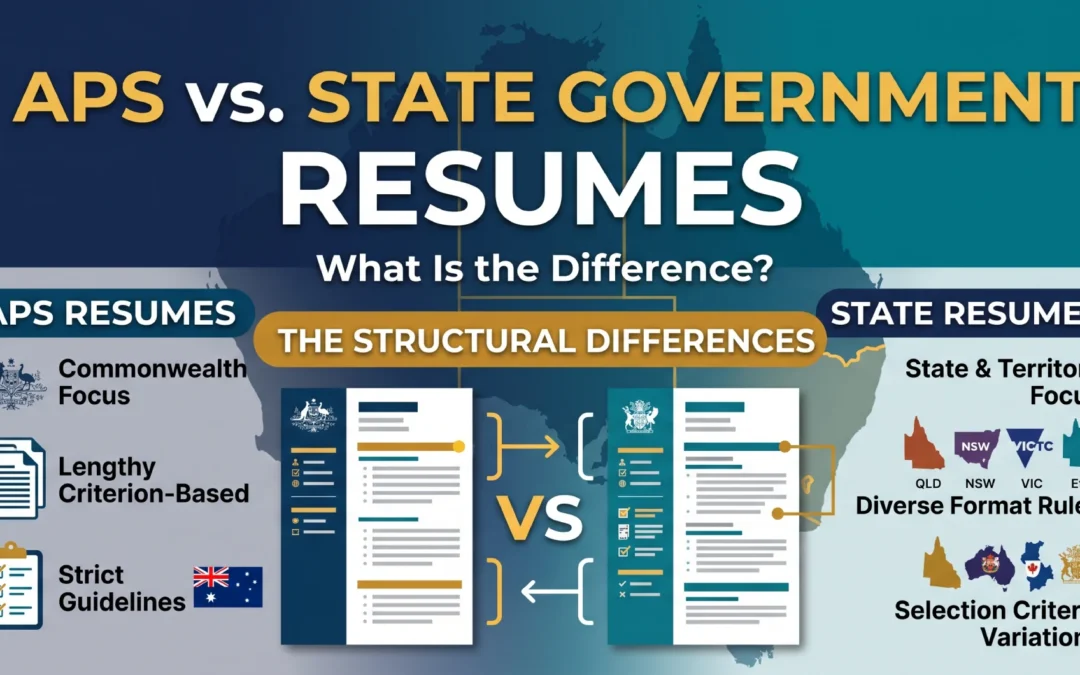
The main difference is how you tailor the evidence in your resume to the employer’s role requirements and capability framework—not a universal difference in page layout. Australian Public Service (APS) applications may draw on the APSC Integrated Leadership System (ILS) and Work Level Standards, while state and territory employers use their own capability frameworks and recruitment instructions. Both generally benefit from clear formatting, relevant achievements and language that reflects the advertised role.
If you’re applying across federal and state government, don’t simply change the department name at the top of your resume. Review the position description, identify the capabilities being assessed and adjust your examples to show the scope, judgement and outcomes relevant to that role.
1. Capability frameworks: APS versus state government
APS: ILS, Work Level Standards and role requirements
The APSC Integrated Leadership System describes leadership behaviours and capabilities across APS classifications. The Work Level Standards help explain the expected work value at each classification. They are useful reference points, but your resume does not need to use ILS capability headings as its section headings unless the vacancy asks for that structure.
For example, an APS6 applicant might highlight independent judgement, stakeholder engagement and delivery of complex work. An EL1 applicant would generally need to show a broader leadership contribution, risk management and delivery through others, as appropriate to the position.
The practical test is whether your examples demonstrate the skills and responsibilities in the advertisement. If the application also requires a pitch or statement of claims, use that document to address the requested criteria directly. Our selection criteria and pitch support explains how these documents complement a resume.
State government: tailor to the jurisdiction and agency
State and territory employers have different frameworks. NSW applicants may need to demonstrate capabilities from the NSW Public Sector Capability Framework. Victorian public service applicants should review the relevant role’s capabilities and Victorian public sector guidance. Queensland applicants should follow the capability expectations and application instructions in the specific role description.
The key is not to copy every capability into your resume. Select achievements that provide convincing evidence against the focus capabilities or selection requirements for the job.
2. Resume formatting and applicant tracking systems
There is no single applicant tracking system used across the APS or every state government employer. Recruitment portals and document-processing capabilities vary by agency and configuration. Nor should applicants assume that an automated system makes the final merit decision: assessment processes depend on the employer and vacancy.
For reliable readability, a simple, accessible resume is usually the safest starting point:
Use clear headings such as Professional Summary, Key Skills, Employment History, Qualifications and Referees (where requested).
Present employment dates, titles and employers consistently.
Prefer a straightforward single-column layout; avoid decorative text boxes and complex tables when they add no value.
Use selectable text rather than an image-only or scanned resume.
Submit the file type requested in the advertisement, whether Word or PDF.
Include relevant terminology naturally, supported by real experience rather than keyword stuffing.
These choices help human assessors read your application and can reduce avoidable parsing issues. They do not guarantee an ATS score, successful parsing or an interview.
3. Resume length: follow the vacancy, not a universal rule
There is no across-the-board rule that APS6 or EL1 resumes must be three to four pages, or that state government resumes can always be longer. The right length depends on the employer’s instructions, the role’s seniority and how much relevant evidence you need to present.
As a practical guide, prioritise your most relevant and recent achievements. A concise resume that demonstrates complexity, responsibility and measurable outcomes is usually more persuasive than a long catalogue of duties.
Before submitting: check the advertisement for page limits, file formats, mandatory application questions, referee requirements and whether a separate pitch or statement is required.
4. How to adapt one resume for both APS and state roles
Suppose you managed a cross-agency project. The underlying achievement stays the same, but the emphasis can change.
APS-focused version: “Coordinated a cross-agency project, advised senior executives on delivery risks and implemented governance improvements that reduced reporting delays by 25%.”
State-government-focused version: “Led service-delivery improvements across regional teams, engaged operational stakeholders and reduced reporting delays by 25%, supporting more timely frontline decisions.”
These are illustrative examples, not claims about a real candidate. Neither version is inherently better. Use whichever emphasis most accurately reflects your experience and matches the advertised requirements. Never change facts or inflate responsibility simply to match framework terminology.
If you’re moving from a private-sector role into government, our private-to-public-sector application support can help you translate commercial experience into relevant public-sector evidence.
5. APS versus state government resumes: quick comparison
Feature
APS applications
State government applications
Capability alignment
Role requirements, potentially informed by APSC ILS and Work Level Standards
Relevant state or territory capability framework and role requirements
Resume structure
Clear professional history and evidence of achievement
Clear professional history and achievement evidence
Formatting
Follow vacancy instructions; simple accessible layouts are a strong default
Follow vacancy instructions; simple accessible layouts are a strong default
Page length
Vacancy-specific; no universal 3–4-page cap
Vacancy-specific; no universal 4–5-page allowance
Supporting documents
May require a pitch, statement of claims or selection criteria
May require capability responses, targeted questions or other statements
What matters most
Demonstrated merit against the role
Demonstrated merit against the role
Frequently asked questions
Can I use the same resume for APS and state government jobs?
You can reuse a strong master resume, but tailor the summary, relevant achievements and capability language for each advertised position. Keep your underlying facts consistent.
Do APS resumes need to be ATS-friendly?
A clear, machine-readable document is sensible, but no format guarantees ATS performance. Follow the agency’s file requirements and make the resume easy for a person to assess.
Is a one-page pitch compulsory for APS jobs?
No. Some APS vacancies request a one-page pitch, while others specify different lengths, statements or application questions. Always follow the individual advertisement.
Should I use ILS headings in my APS resume?
Not automatically. Use headings that make your career evidence easy to scan. Draw on ILS or Work Level Standards where relevant to the vacancy, particularly when choosing and describing achievements.
How long should a state government resume be?
Use any stated page limit. Otherwise, include enough relevant evidence to demonstrate suitability without repeating duties or unrelated career history.
Get expert help tailoring your government resume
A strong government resume does more than list previous responsibilities. It helps a selection panel understand what you delivered, how you exercised judgement and why your experience matches the position.
At PS Interview Coach, we help applicants align their resumes and supporting statements with the actual requirements of APS and state government roles. Explore our government resume writing services or book a free strategy call to discuss your next application.
Updated: October 2026 Estimated read time: 12 minutes
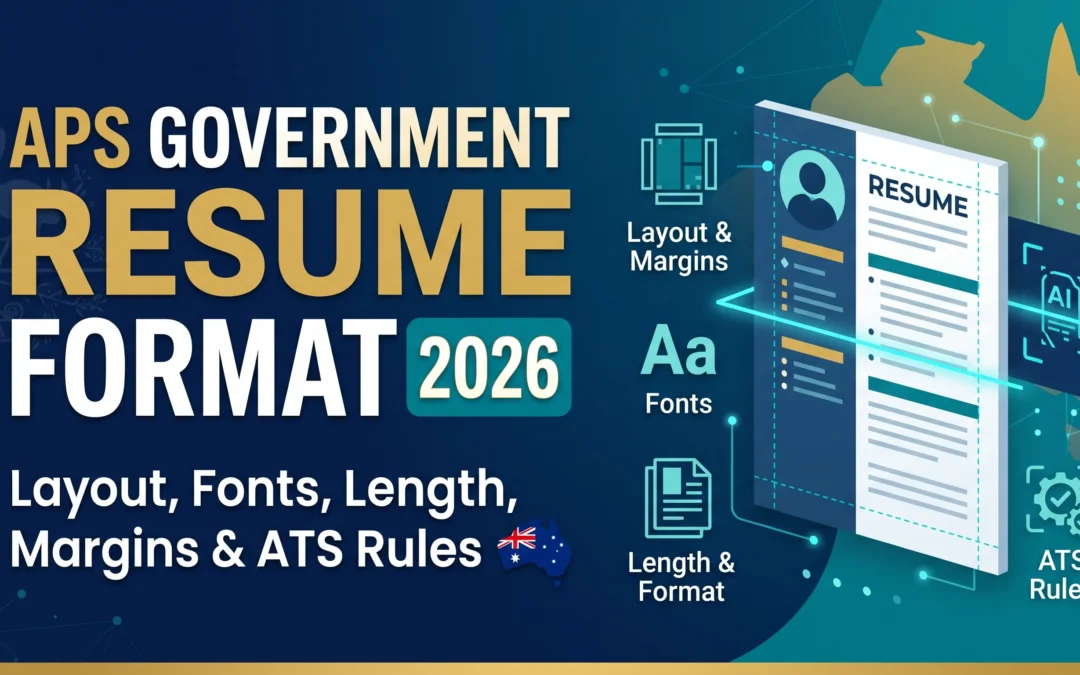
APS Resume Format 2026-27: The Exact Layout, Fonts, Margins and Length Government Panels Expect
Why Does APS Resume Format Matter More Than Design?
An Australian Public Service resume has one job: to give a selection panel fast, accurate evidence that you can perform at the advertised classification level. It is not a marketing brochure, and it is not judged on visual flair.
Two readers see your resume. The first is the agency’s e-recruitment system (many APS and state agencies use platforms such as PageUp), which extracts your details into a candidate record. The second is the selection panel, who are often reading dozens of applications in a short window and assessing every candidate against the same criteria under the merit principle.
Creative layouts work against both readers. Multi-column designs, sidebars, tables, text boxes, icons and skill-rating bars can scramble when a system parses them, and they slow a panel member down when they are scanning for evidence. A plain, well-structured document does the opposite: it parses cleanly and lets your achievements do the work.
The APSC’s own Cracking the Code guidance is also clear that, in most cases, a CV alone will not win an APS job. It works alongside your pitch or selection criteria response. That means your resume should be built to support your written claims, not repeat them.
What Are the Technical Rules for an APS Resume?
These settings give you a document that parses reliably, prints cleanly for panel bundles, and stays stable across different versions of Microsoft Word.
APS and state government resume formatting specifications
Element
Recommended setting
Layout
Single column only. No tables, text boxes, columns, sidebars, icons or graphics.
File type
Microsoft Word (.docx), unless the advertisement asks for PDF.
Font
One family throughout: Calibri, Arial, Aptos or Georgia.
Your name
18 to 22 pt, bold.
Section headings
14 pt, bold, using Word’s built-in Heading styles.
Body text
11 pt (never below 10 pt).
Line spacing
1.0 to 1.15, with 6 pt spacing after paragraphs.
Margins (all sides)
2.54 cm (Word’s “Normal” setting). Never narrower than 2 cm.
Header and footer distance
1.27 cm from the page edge.
Bullet points
Standard round bullets only. Avoid custom symbols, arrows or ticks.
Why Word (.docx) Instead of PDF?
Word files are the most reliably parsed format across government e-recruitment systems, and panels sometimes need to compile or annotate applications. Submit a PDF only when the advertisement asks for one. If the system accepts both and gives no preference, .docx is the safer choice.
Why 1.15 Line Spacing Rather Than 1.5?
Line spacing of 1.5 looks generous on screen but consumes roughly a third more space, which quickly pushes you over a page limit. Spacing of 1.0 to 1.15 with a small gap after each paragraph gives the same breathing room without costing you a page of evidence.
Use Word’s Built-In Heading Styles
Apply Heading 1 or Heading 2 styles to section titles rather than simply making text bold and larger. Built-in styles help parsing software identify sections, improve accessibility for screen reader users, and make the document easier to reformat if an agency imposes a different limit.
How Long Should an APS Resume Be?
The APSC notes that most CVs it sees fall somewhere between two and six pages. Within that range, length should be driven by your target level and the relevance of your experience, not by how much you have done.
Recommended APS resume length by classification
Target classification
Recommended length
APS 3 to APS 5
2 to 3 pages
APS 6 to EL1
3 to 4 pages
EL2
4 to 5 pages
Senior Executive Service (SES)
Up to 5 pages
The job advertisement always overrides these ranges. Many APS and state agencies now specify a strict limit, commonly two pages. Exceeding a stated limit tells the panel you cannot follow instructions, and some agencies will only read up to the limit.
Most candidates find it easiest to keep a longer “master” resume and cut it down for each application, removing older or less relevant roles first.
What Should Go in the Header and Footer of an APS Resume?
Keep headers and footers functional and minimal. Never place tables or text boxes inside them.
First page header: leave blank. Your name and contact details belong in the main body of page one.
Header on pages 2 onwards: your full name and phone number in 9 pt, right-aligned. In Word, use “Different First Page” to set this up.
Footer on every page: page numbering in the format “Page X of Y”, centred or right-aligned.
Page numbering matters because applications are often printed or merged into panel bundles. “Page 2 of 3” tells a panel member immediately if a page has gone missing.
One important caution: some parsing systems ignore headers and footers entirely. Never put contact details only in the header, or the system may record your application without them.
What Is the Recommended Structure for an APS Resume?
Use this order. It front-loads the information panels look for first: who you are, what level you work at, and whether you meet any eligibility requirements.
Contact information: full name, phone, email, city or location, Australian citizenship status, and security clearance level if you hold one.
Professional summary: three to four lines covering your field, level and primary value.
Core capabilities: four to six capabilities aligned to the target role.
Employment history: reverse chronological order, most recent first.
Education and qualifications: degrees, diplomas and relevant certifications with completion years.
Clearances and professional memberships: if not already listed in your contact block.
Referees: two professional referees, ideally including your current or most recent direct manager.
Contact Information and Citizenship
Australian citizenship is a standard condition of engagement for most APS roles, and many roles require a security clearance. Stating both at the top saves the panel from searching for eligibility information. List your clearance level and whether it is active (for example, “Baseline (Active)” or “NV1 (Active)”). Do not include clearance reference numbers or other identifying numbers.
Professional Summary
Write the summary in the silent first person, which means dropping the “I”. For example, “Lead policy development and stakeholder engagement across…” rather than “I lead policy development…”. Name your field and level, and anchor the summary in public sector value rather than generic adjectives such as “results-driven” or “passionate”.
Core Capabilities
Choose four to six capabilities that mirror the language of the position description and the relevant capability framework. For APS roles, that means the APSC Integrated Leadership System (ILS) and the APS Work Level Standards. Keep each capability to a short heading plus one line of evidence. A bare list of keywords does little for a panel.
Employment History
For each role, include:
Job title and APS classification, or a brief scope indicator for non-APS roles (team size, budget, or reporting line)
Department, agency or organisation, and branch or division
Start and end dates in month and year format
A two to three line role overview
Key responsibilities (three to five bullets)
Key achievements with measurable outcomes (two to four bullets)
Roles older than 15 years can usually be removed or condensed into a single “Earlier career” line unless they are directly relevant. Acting roles at a higher level should be listed clearly with their duration, because they are strong evidence of readiness for promotion.
The difference between a responsibility and an achievement is where most APS resumes fall short. Panels are looking for what changed because you were there, at a level of complexity that matches the classification. If you need help converting duties into level-appropriate evidence, see our APS ATS resume and application services.
Referees
Provide two professional referees with their current title, organisation, phone number and email. Choose people who can speak to the capabilities in the role, not just your technical output. Let your referees know in advance and send them the position description.
What Should You Leave Off an APS Resume?
Australian public sector recruitment is assessed on merit, so personal details unrelated to the work should be omitted:
Photograph
Date of birth or age
Gender and marital status
Full home street address (city or suburb is enough)
Tax file number, driver’s licence number or any other identification number
Salary history or salary expectations
Hobbies and interests, unless directly relevant to the role
“References available on request”
If you are applying through the APS RecruitAbility scheme, that opt-in is usually handled in the application form rather than on your resume.
Does the Resume Format Change for State Government, AFP, ADF or NDIA Roles?
The technical layout rules above apply across Australian public sector recruitment. What changes is the capability language you align to:
Federal APS agencies (including the NDIA, Services Australia, ATO and Department of Defence civilian roles) use the APS ILS and Work Level Standards.
The AFP uses its own Work Level Standards, which correlate to the ILS, and maps its band structure to APS classifications.
NSW Government roles align to the NSW Public Sector Capability Framework.
Victorian Public Service roles use VPS classifications and key selection criteria set out in the position description.
Queensland Government roles commonly use AO classifications and the Leadership competencies for Queensland.
State government advertisements are often more prescriptive about resume length and cover letter format, so read the applicant information pack closely. For tailored support with state roles, see our state government interview coaching.
Copy the template below into a blank Word document. Set the font to Calibri 11 pt and margins to 2.54 cm, then apply the sizes shown in square brackets. Replace every placeholder with your own evidence.
[11 pt] Public sector policy professional with [number] years of experience at [level, e.g. APS 6] in [field, e.g. regulatory policy]. Lead [core function 1], [core function 2] and [core function 3] across [context, e.g. federal and state stakeholders]. Known for [specific value, e.g. turning complex legislation into clear advice for senior executives and Ministers].
[14 pt Bold] CORE CAPABILITIES
Policy and Strategy: Research complex issues, analyse data and develop evidence-based policy advice.
Stakeholder Engagement: Build collaborative partnerships across Commonwealth, state and territory agencies.
Written Communication: Draft ministerial briefs, Senate Estimates material and governance reports.
Project Delivery: Track and report on program milestones, risks and budgets.
[14 pt Bold] EMPLOYMENT HISTORY
[11 pt Bold] Policy Officer | APS 6
[11 pt] Department or Agency Name | Branch or Division
Month YYYY – Present
Role overview: Two to three lines on your mandate, who you report to and your team’s primary objective.
Key responsibilities:
Manage the end-to-end delivery of [project or program name].
Coordinate consultation with internal and external stakeholders to support regulatory alignment.
Provide advice and draft briefs, submissions and executive documentation.
Key achievements:
Led delivery of [initiative], reducing [measure] by [percentage or amount].
Drafted [number] high-priority ministerial briefs cleared by senior leadership within agreed timeframes.
[11 pt Bold] Program Support Officer | APS 5
[11 pt] Department or Agency Name | Branch or Division
Month YYYY – Month YYYY
Role overview: Two to three lines on the environment and your core function.
Key responsibilities:
Supported senior management with risk monitoring, milestone tracking and secretariat duties.
Interpreted program guidelines to give accurate, timely advice to service delivery partners.
Key achievements:
Identified a bottleneck in the compliance workflow and redesigned the process, improving turnaround by [percentage].
[14 pt Bold] EDUCATION AND QUALIFICATIONS
[11 pt Bold] Bachelor of Arts (Public Policy) | YYYY
[11 pt] University Name, Location
[11 pt Bold] Diploma of Government | YYYY
[11 pt] Registered Training Organisation Name
[14 pt Bold] PROFESSIONAL REFEREES
[11 pt Bold] Referee Name 1
[11 pt] Current Title | Department or Agency Name
P: 0400 000 000 | E: referee1@email.gov.au
[11 pt Bold] Referee Name 2
[11 pt] Current Title | Department or Agency Name
P: 0400 000 000 | E: referee2@email.gov.au
A template gives you the right structure. It cannot tell you which of your examples will land at the level being assessed, or how to describe your achievements so a panel recognises EL1 judgement rather than APS 6 delivery. That is where most applications are won or lost.
What Are the Most Common APS Resume Formatting Mistakes?
Using a two-column template. Sidebars for skills or contact details often parse out of order or disappear.
Building the layout with tables or text boxes. They look tidy in Word and break in parsing software.
Ignoring the stated page limit. A four-page resume against a two-page limit is a poor first impression.
Listing duties instead of achievements. A copied position description tells the panel what the job was, not how well you did it.
Writing for the wrong level. Examples need to reflect the complexity, autonomy and decision-making described in the Work Level Standards for the target classification.
Repeating the pitch word for word. Your resume and pitch should complement each other, with the resume supplying context and the pitch supplying your strongest evidence.
Mixing fonts and styles. Inconsistent formatting signals a lack of attention to detail, which panels notice.
Unexplained gaps. A one-line explanation (study, caring responsibilities, travel) is better than leaving a panel to guess.
Frequently Asked Questions About APS Resume Format
What is the best resume format for APS jobs?
The best format is a single-column, reverse chronological Microsoft Word document with no tables, text boxes, columns or graphics. Use one professional font such as Calibri or Arial at 11 pt, 2.54 cm margins, and clear section headings built with Word’s Heading styles. This layout parses cleanly in e-recruitment systems and is fast for selection panels to scan.
How long should an APS resume be?
As a general guide, aim for 2 to 3 pages at APS 3 to APS 5, 3 to 4 pages at APS 6 to EL1, 4 to 5 pages at EL2, and up to 5 pages at SES level. The APSC notes most CVs fall between two and six pages. Any page limit in the job advertisement always takes priority, and many agencies now set a two-page limit.
Should I submit my APS resume as a Word document or PDF?
Submit a Word (.docx) file unless the advertisement asks for PDF. Word documents parse most reliably in government e-recruitment systems and can be compiled into panel bundles easily.
What font and size should I use on an APS resume?
Use one font family throughout, such as Calibri, Arial, Aptos or Georgia. Set body text at 11 pt, section headings at 14 pt bold, and your name at 18 to 22 pt bold. Never go below 10 pt for body text.
Should I include a photo or date of birth on an APS resume?
No. Australian public sector recruitment is based on merit, so leave off your photo, date of birth, age, gender and marital status. Include only information relevant to assessing your capability and eligibility for the role.
Should I put my security clearance and citizenship on my resume?
Yes. State your Australian citizenship and your security clearance level and status (for example, “NV1 (Active)”) in the contact section at the top of page one. Many APS roles require citizenship and a clearance, so this helps panels confirm eligibility quickly. Do not include clearance reference numbers.
Do APS agencies use applicant tracking systems to reject resumes?
Many agencies use e-recruitment platforms such as PageUp to collect and manage applications, and these systems parse your resume into a candidate record. Shortlisting decisions are generally made by a selection panel assessing candidates on merit, but a resume that parses badly can arrive incomplete or jumbled, which weakens your application before a person reads it. A clean single-column format avoids that risk.
Is a state government resume format different from an APS resume?
The layout rules are the same: single column, Word format, professional font and reverse chronological history. The difference is the capability language. Align your resume to the relevant state framework, such as the NSW Public Sector Capability Framework or Queensland’s Leadership competencies, and follow any length or format instructions in the applicant information pack.